Wednesday night the bells of every cathedral in France rang in unison. All one hundred of them. It was a keening; it was the way whales surround an injured member of their family and make those sounds (singing/praying?) that seem to say “we know you are hurt but you are not alone, we are with you.”
Our hearts were completely out of order this past Monday night, at the beginning of Holy Week, as we watched in disbelief the news of the burning of Notre-Dame de Paris, this vessel which holds 850 years of faith, devotion, history, culture, art. This loss for France—our country now—is impossible to overstate.
For us personally, as well, this was one of our most sacred of places. We’ve prayed there countless times, attended Mass, reverenced the Crown of Thorns. The guided tours John gave there were his favorite experience from our Show Me Paris tour days. The thought that this was all being lost before our eyes made us almost physically ill, and we went to bed that night in exhausted despair.
We’re still getting over the gut-punch of the fire, but in the days since, we’ve been thinking of an old Johnny Cash song, One Piece at a Time. In it, an automobile worker smuggles home car parts in his lunch pail every night, over many years. In the end, the free car he assembles at home is one-of-a-kind, a “ ‘forty-nine, fifty, fifty-one, fifty-two…(through the sixties) automobile.”
Notre-Dame de Paris (all Cathedrals in France are named in part after Our Lady, Notre Dame) seems a bit like that, a “Twelfth century, Thirteenth century, Nineteenth century…” cathedral. There wasn’t/isn’t a lot of the original mediaeval church left untouched. And even that church was built on the site of previous churches, from the fourth through ninth centuries, with recycled parts, including the Sainte-Anne portal that you enter on the right side of the façade.
In the 13th century, they replaced some of the 12th century stained glass. In the 14th, they added their own touches. Much of the present day façade is a 19th century recreation of what was destroyed in the late 18th century French Revolution. It was those revolutionaries who destroyed the original mediaeval spire. The “gothic” spire we saw so dramatically collapse on Monday was erected in the 19th century, part of Notre-Dame’s restoration which came after Victor Hugo shamed the nation with his tale of a lovesick hunchback and a once-majestic cathedral, become derelict.
Now we shall see what the 21st century has to add to this old survivor. France, like the rest of Europe, has long nurtured skilled artisans who will know how to rebuild the cathedral for the greater glory of God.
President Macron promises it will all be done in five years which seems gloriously optimistic. But large parts of the original mediaeval cathedral were done in only twenty years. It took longer to finish because they ran out of money to pay the required skilled artisans of the time…and only ran out of money because it was decided from the outset that, of every sou raised for the cathedral, half would go towards the building of a charity hospital, the Hotel-Dieu. The cornerstones of the two buildings were laid the same day.
This slideshow requires JavaScript.
Perhaps we could pray that, of all the money to be raised now for the years of work ahead, once again half would go to serving those who are hungry, homeless, sick, suffering…to refugees…to the rebuilding of our planet.
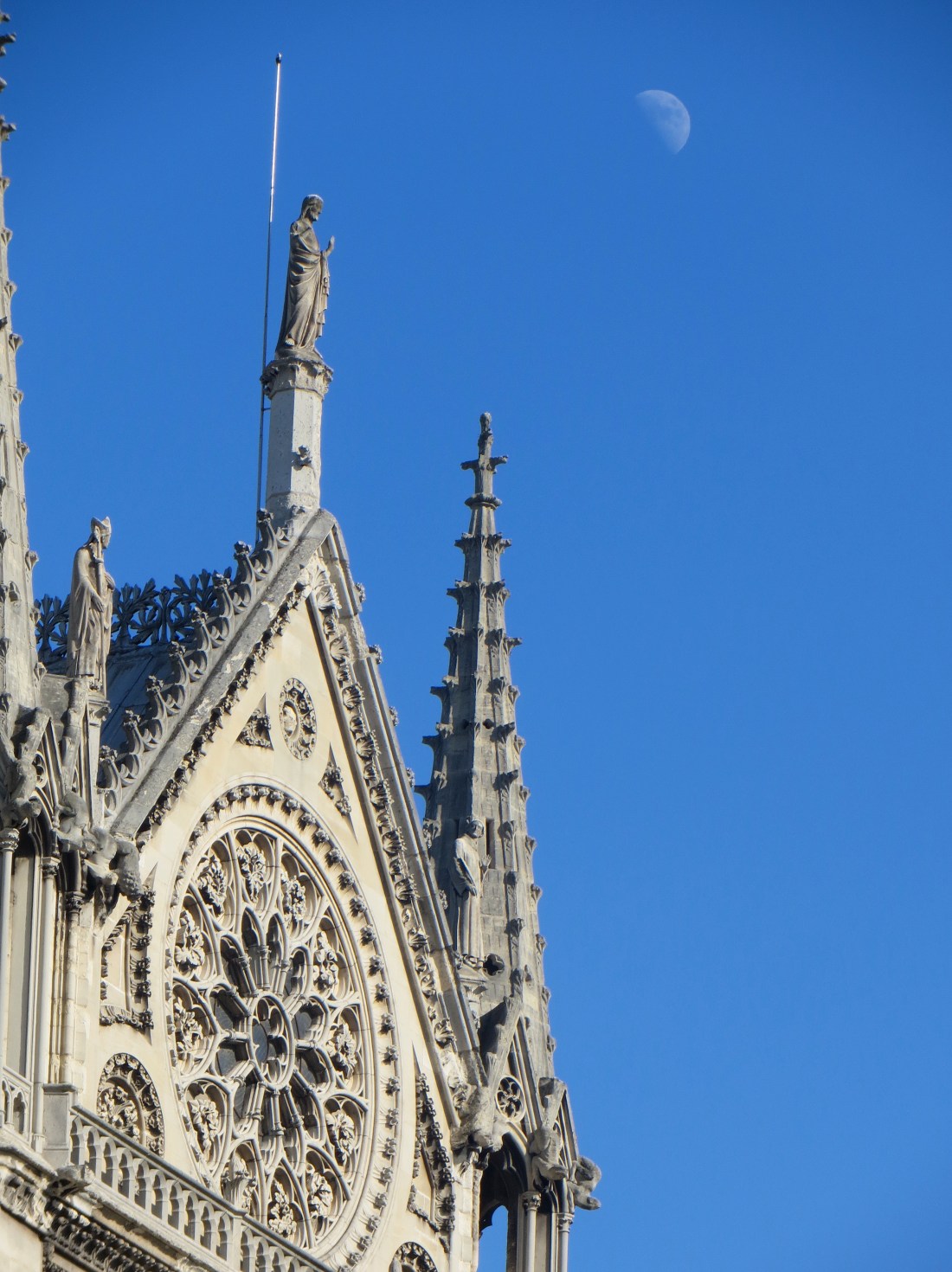
Even with all that has been lost in this calamitous fire, there are survivors, including, astonishingly, the precious Rose windows, relics, and that “Bible in stone,” the façade. And most importantly, the true treasure of Notre-Dame survives, through all those people (thirteen million a year in our own century) who passed through it and carried away with them the chance to be touched by the sacred.
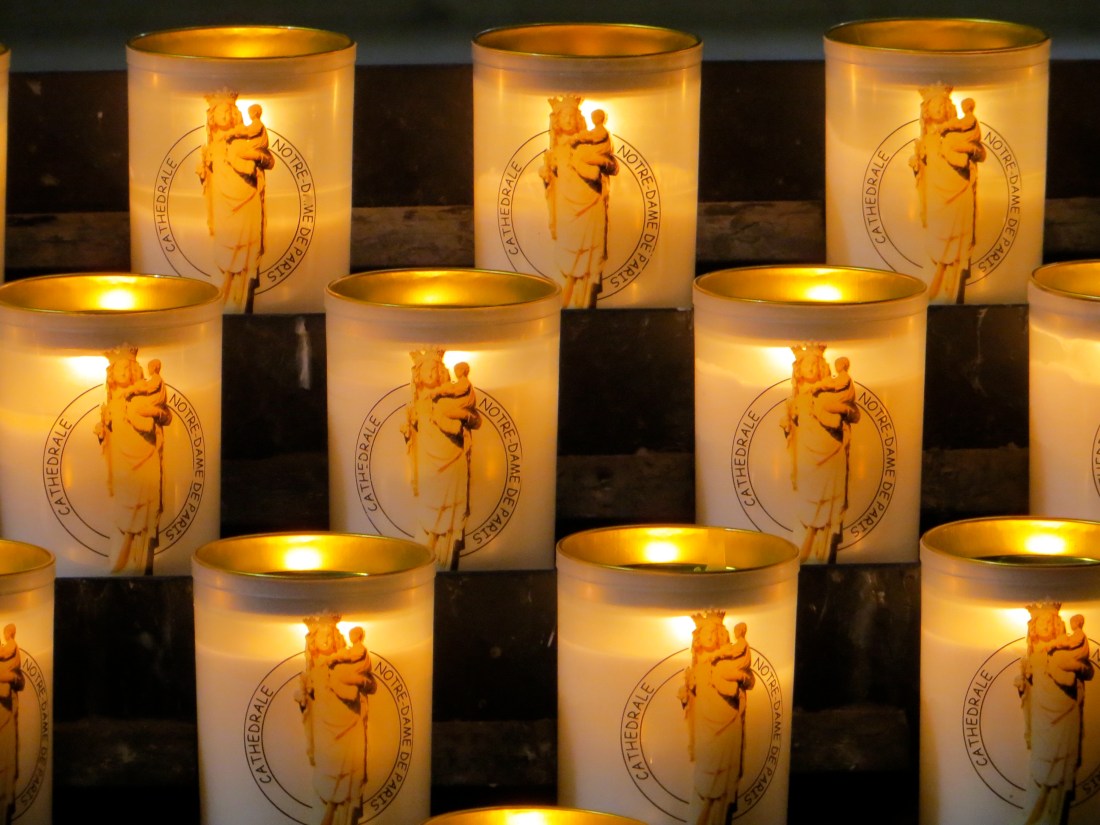
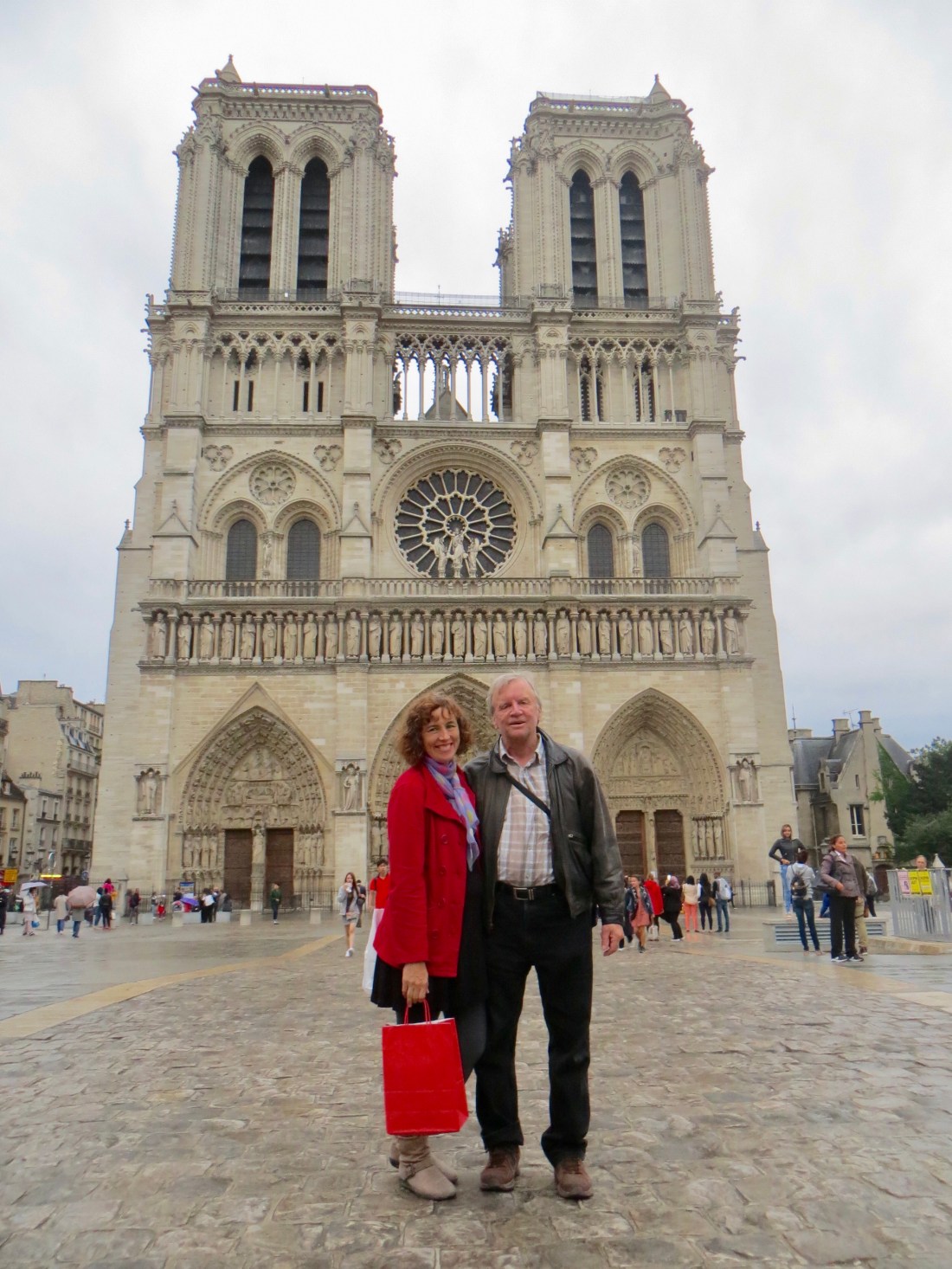
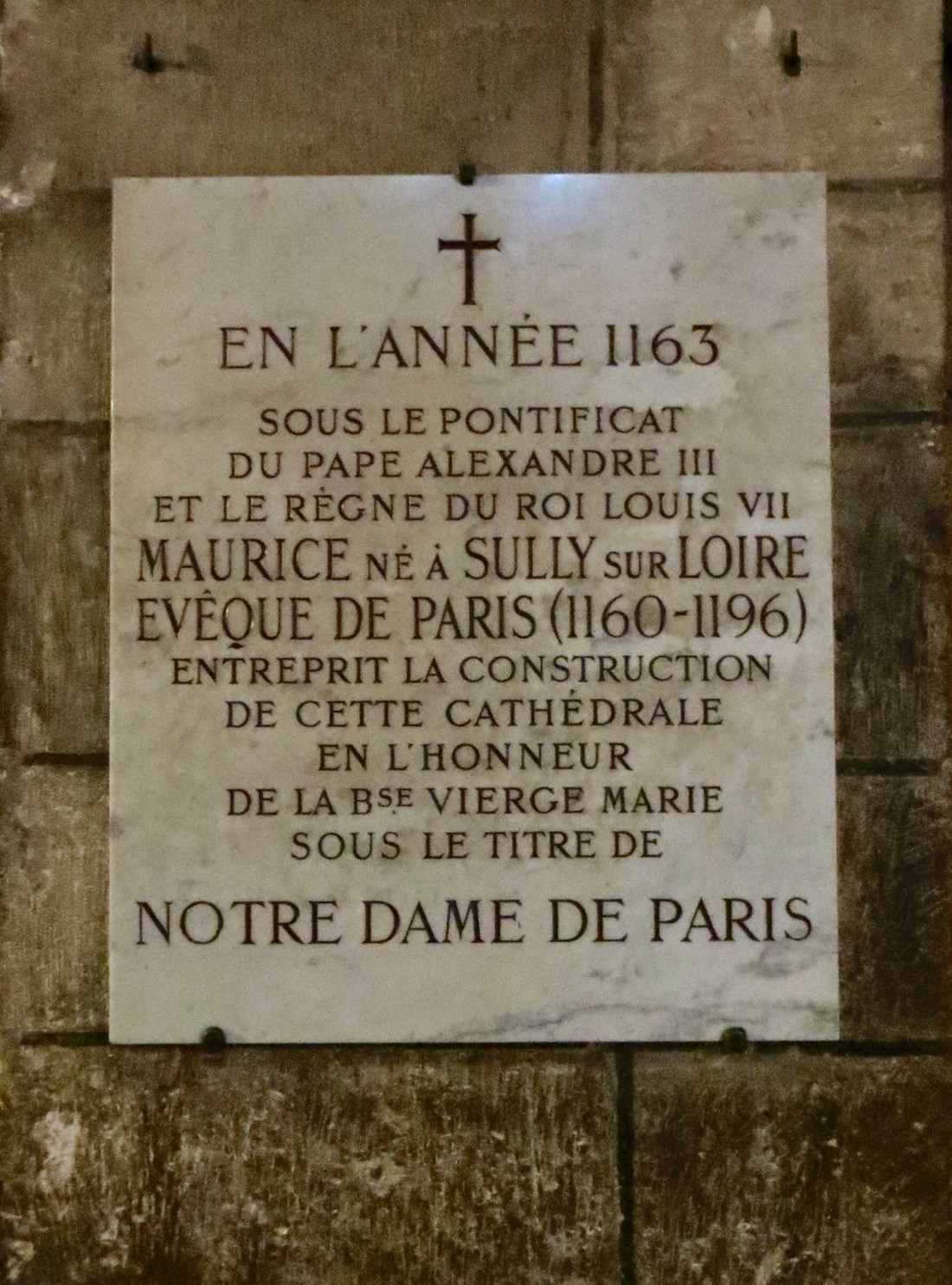
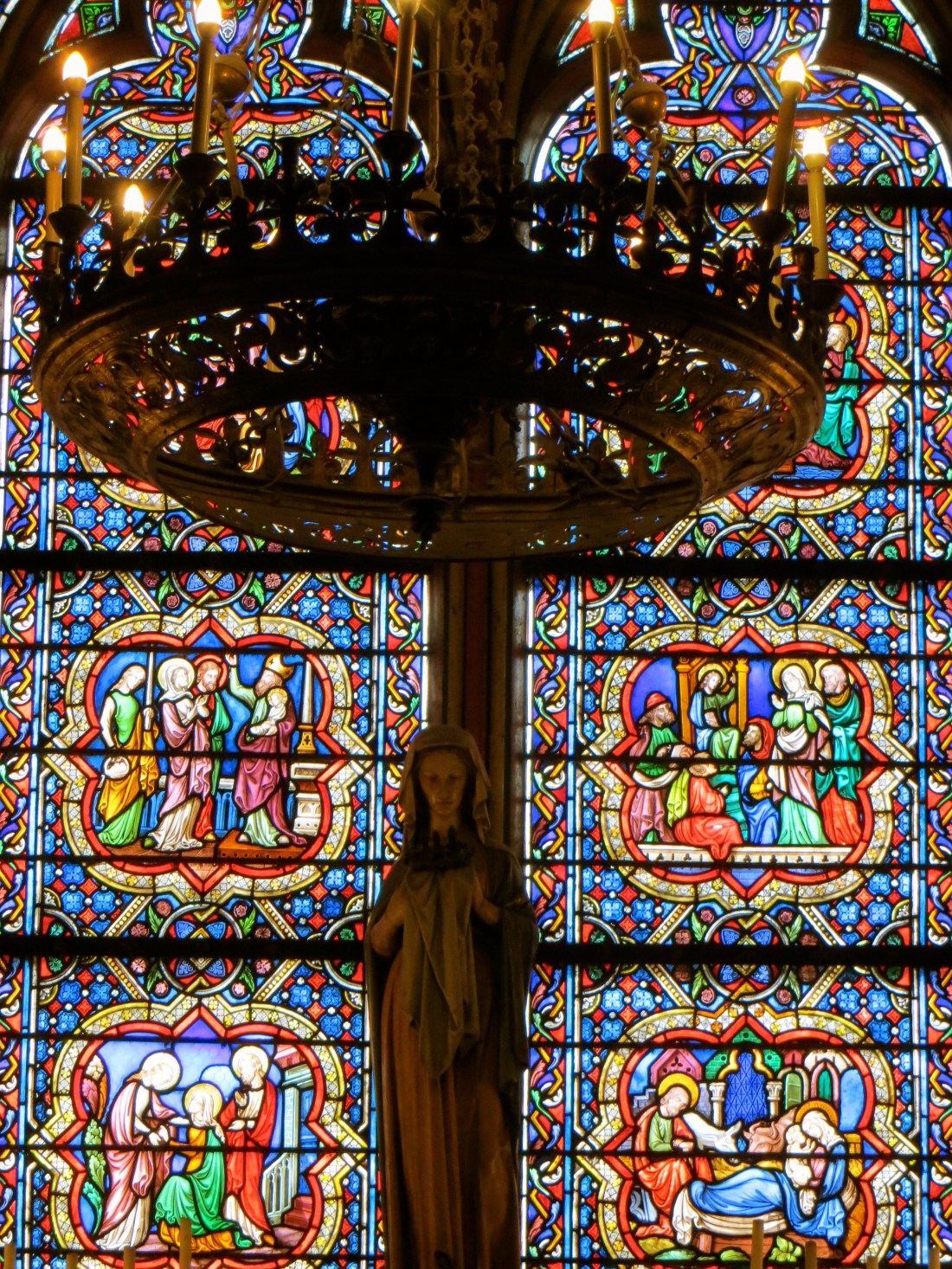
Below you can see a few of our own photographs of Notre-Dame.
As we move through this Holy Week, our hearts hold the miracle of the Resurrection that comes after death, the trust in the Eternal.
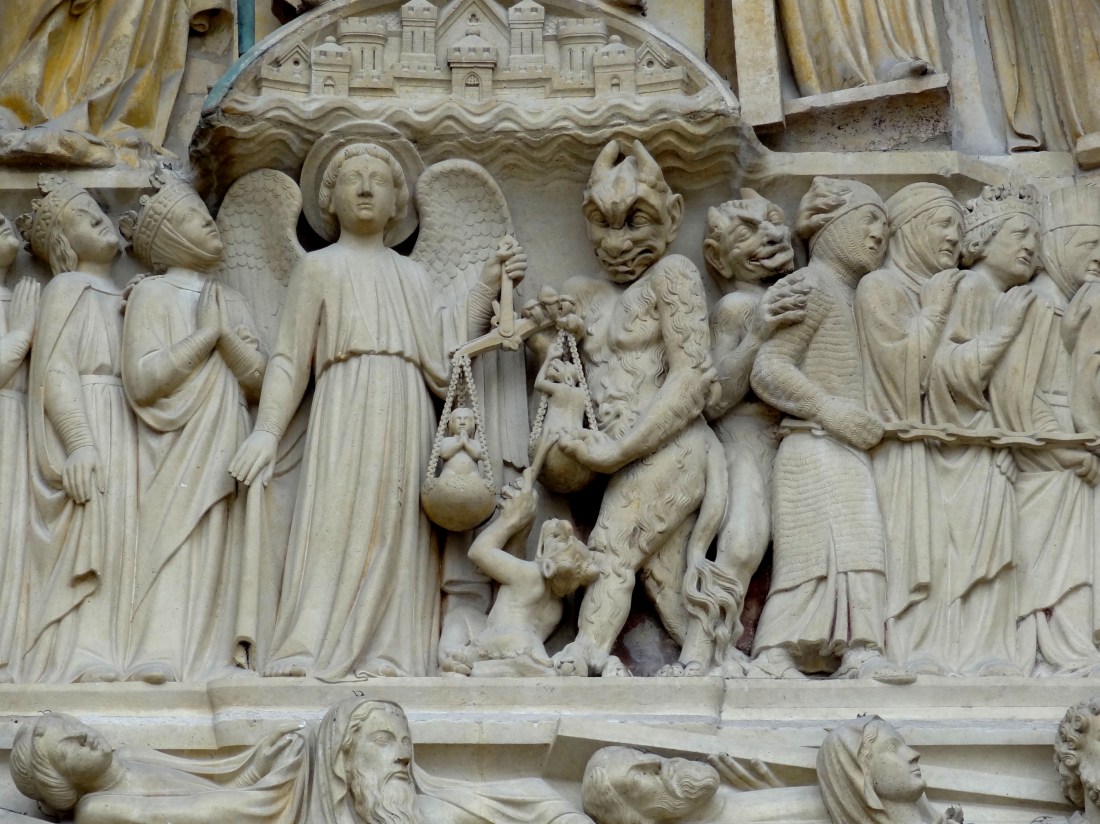
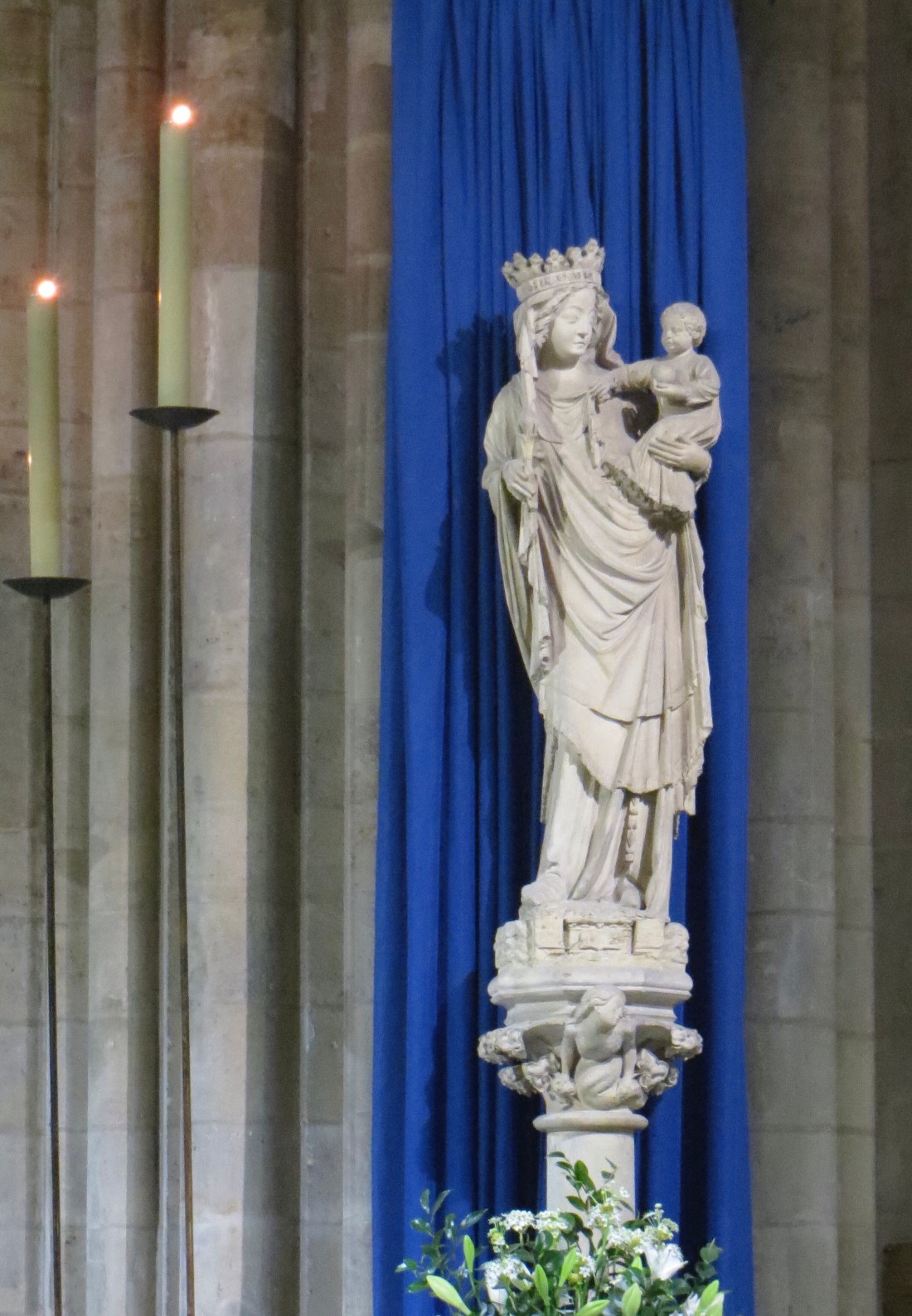
From central portal on the façade: As souls are weighed on Judgment Day, the Devil tries to tip the scales. The damned are not chained; they lead themselves into Hell.This 13th c. statue of Notre Dame came to the Cathedral from another church in the 19th c. Only meters from the collapsed spire, it miraculously escaped unscathed.
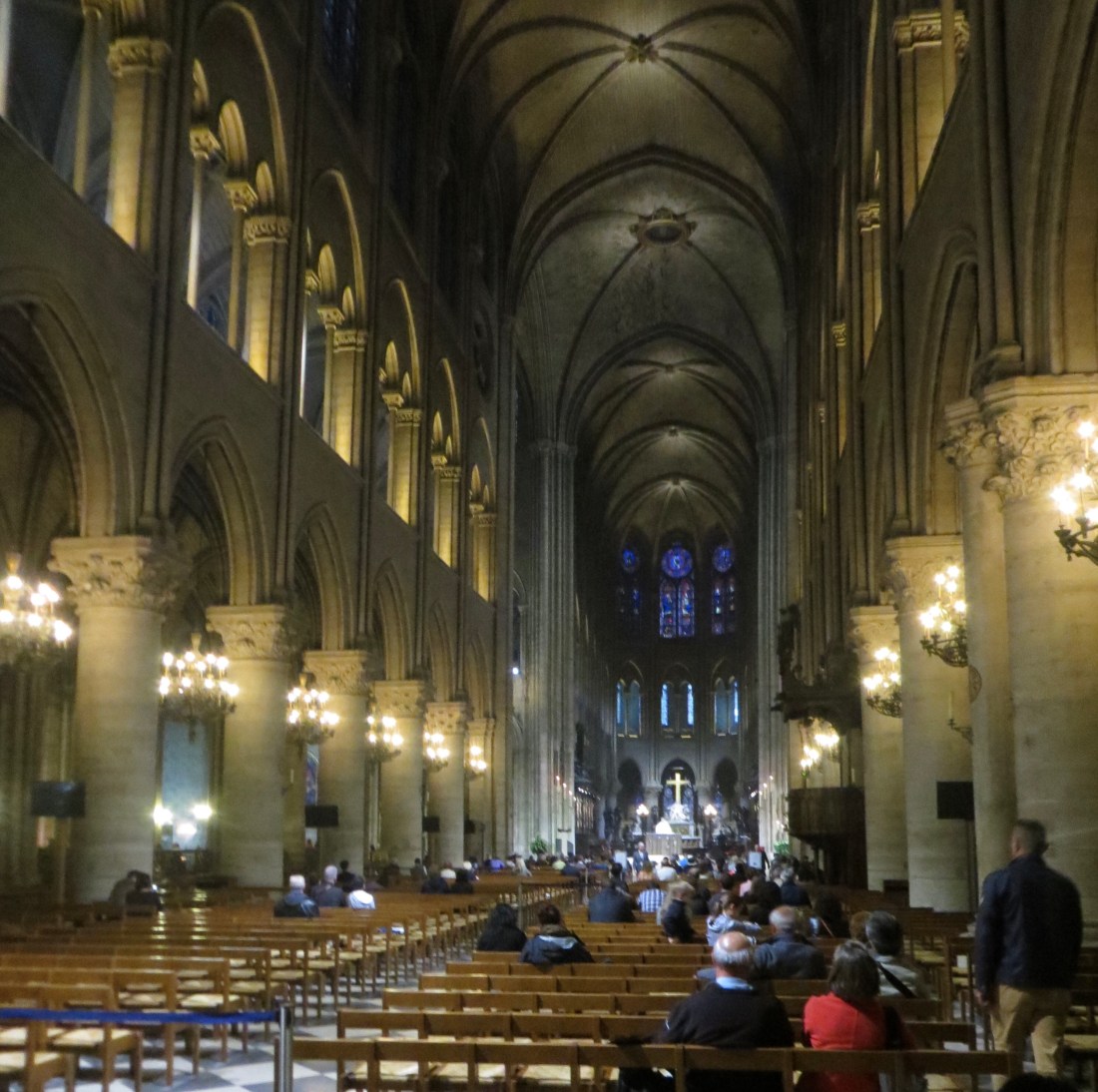
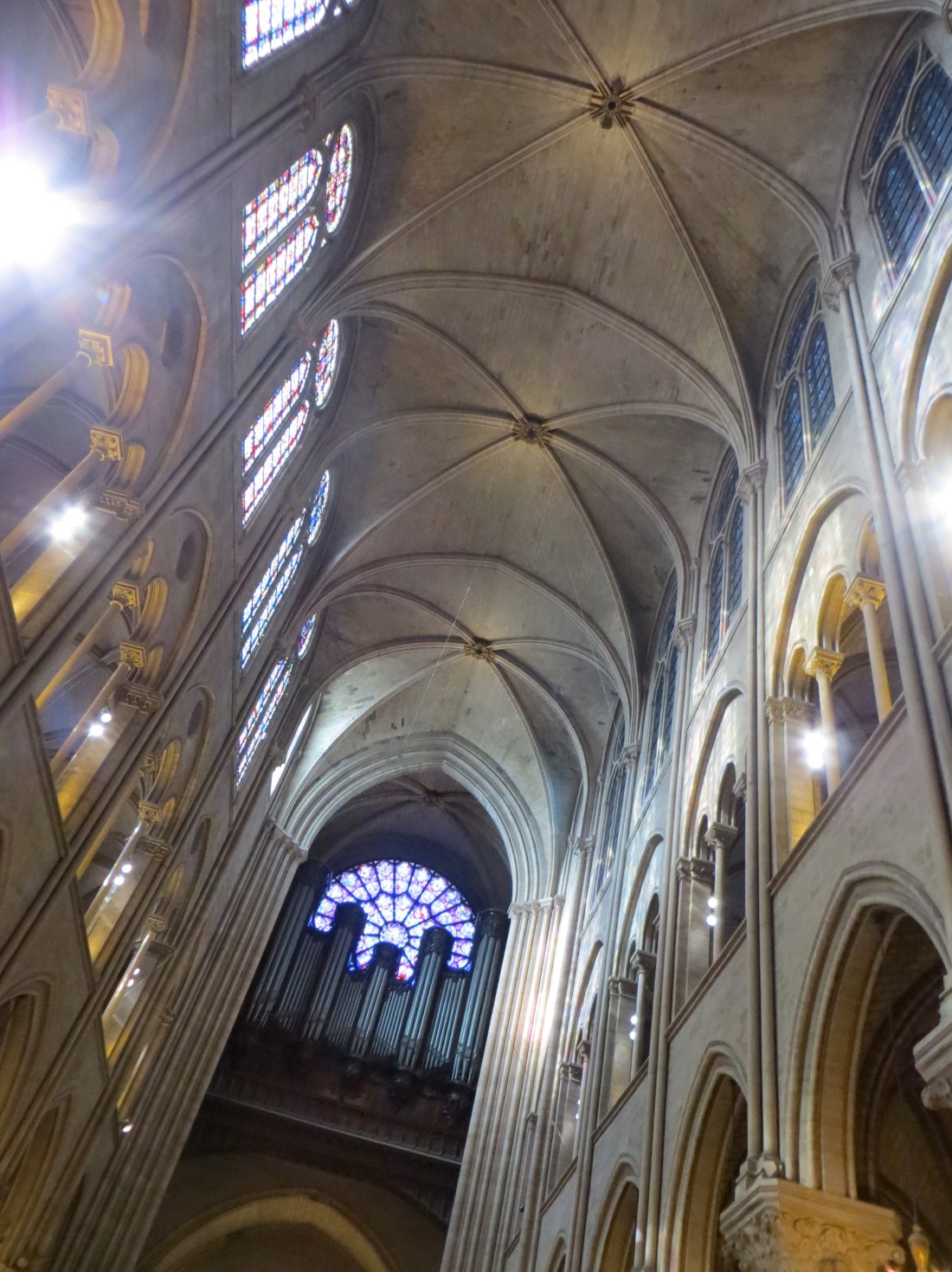
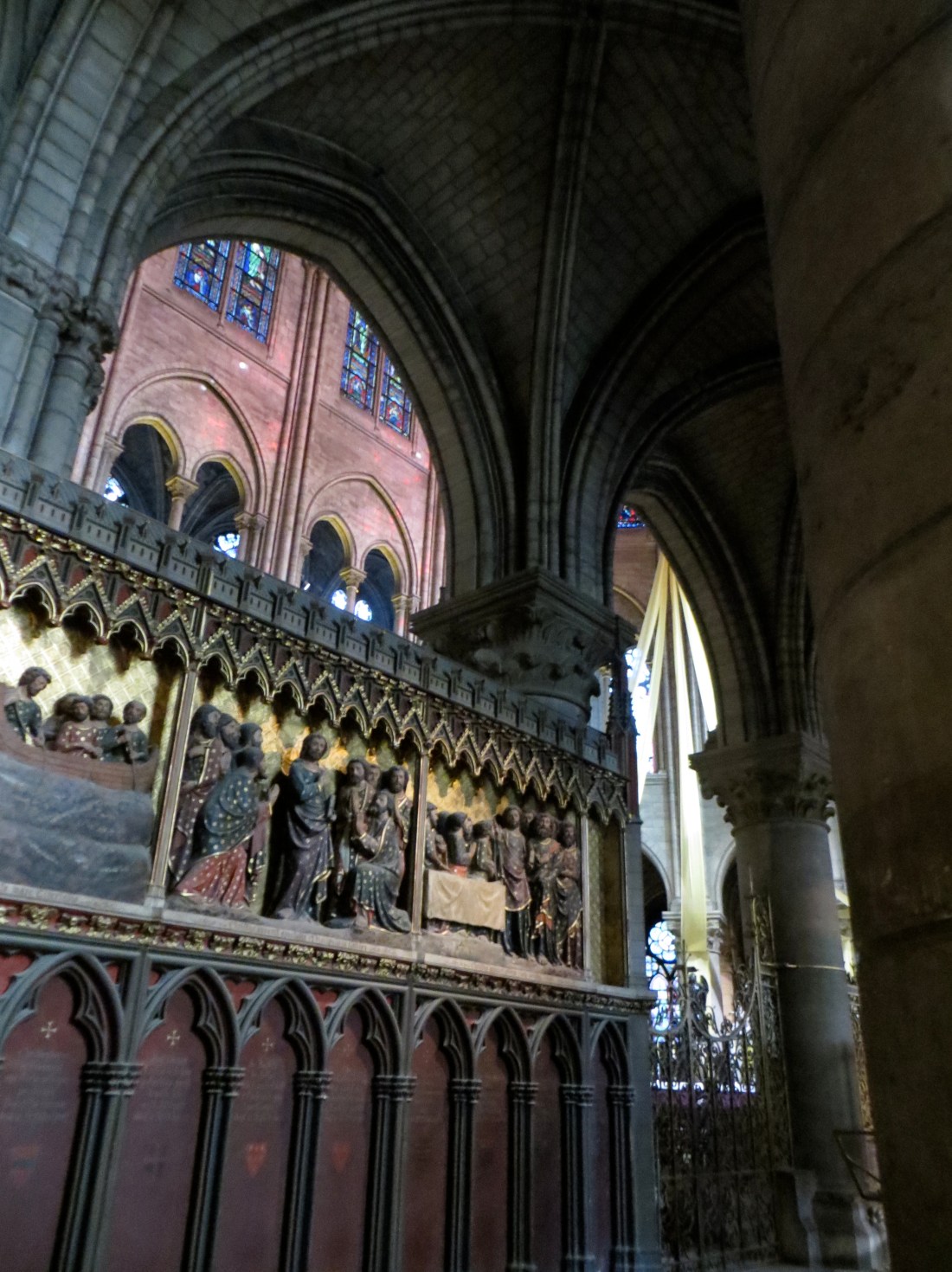
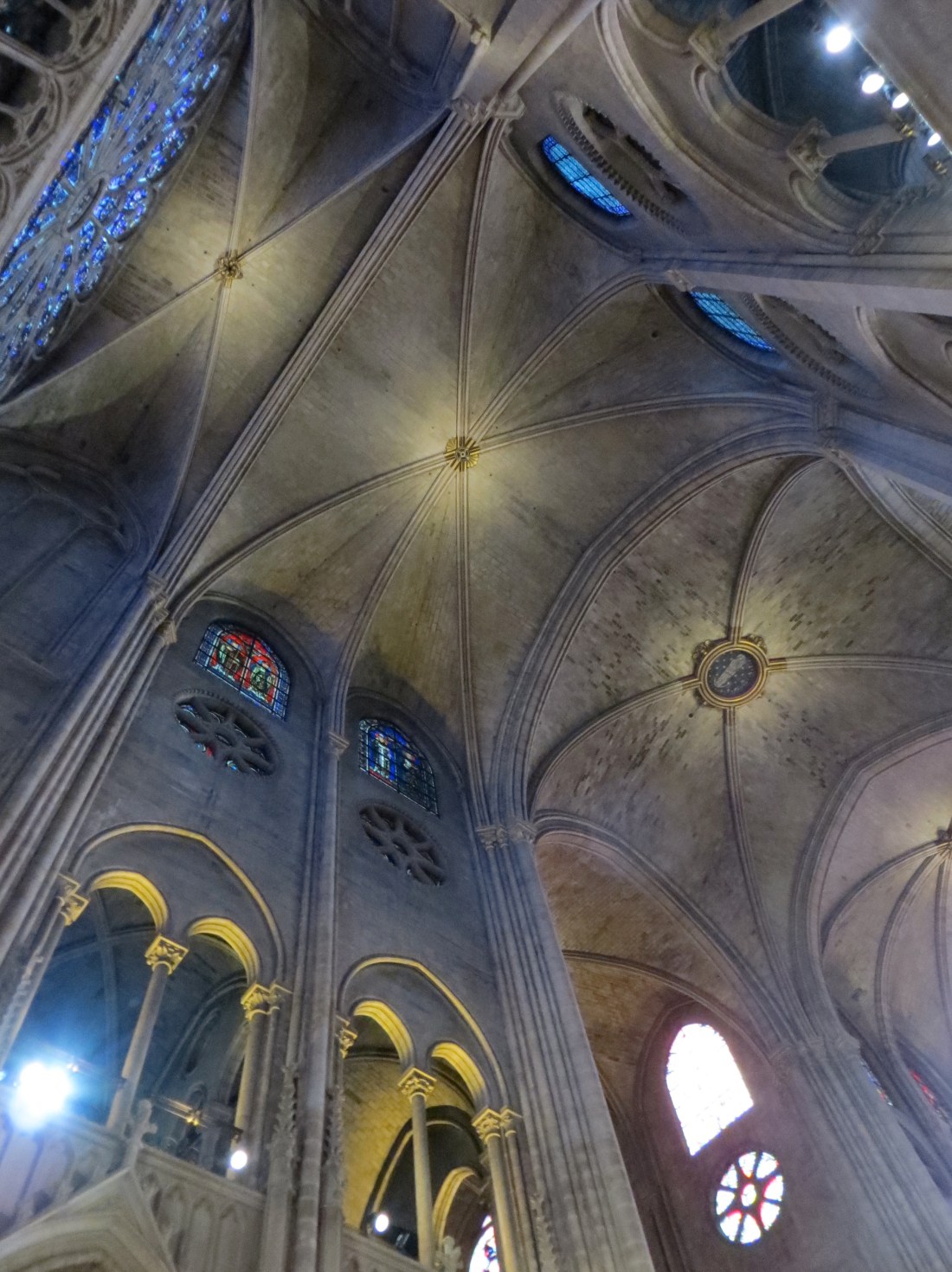
The largest organ in France–5 keyboards and over 8,000 pipes–survived the fire but its damage is still being assessed. “God is Light” was the inspiration behind the 12th century cathedrals. It was the knowledge gained from Moorish architects (the Muslims of what is present-day Spain) which made the ribbed vaulted ceilings possible. And the ribbed vaulting opened the possibility of lighter walls and expanses of stained glass. “Let there be Light.”
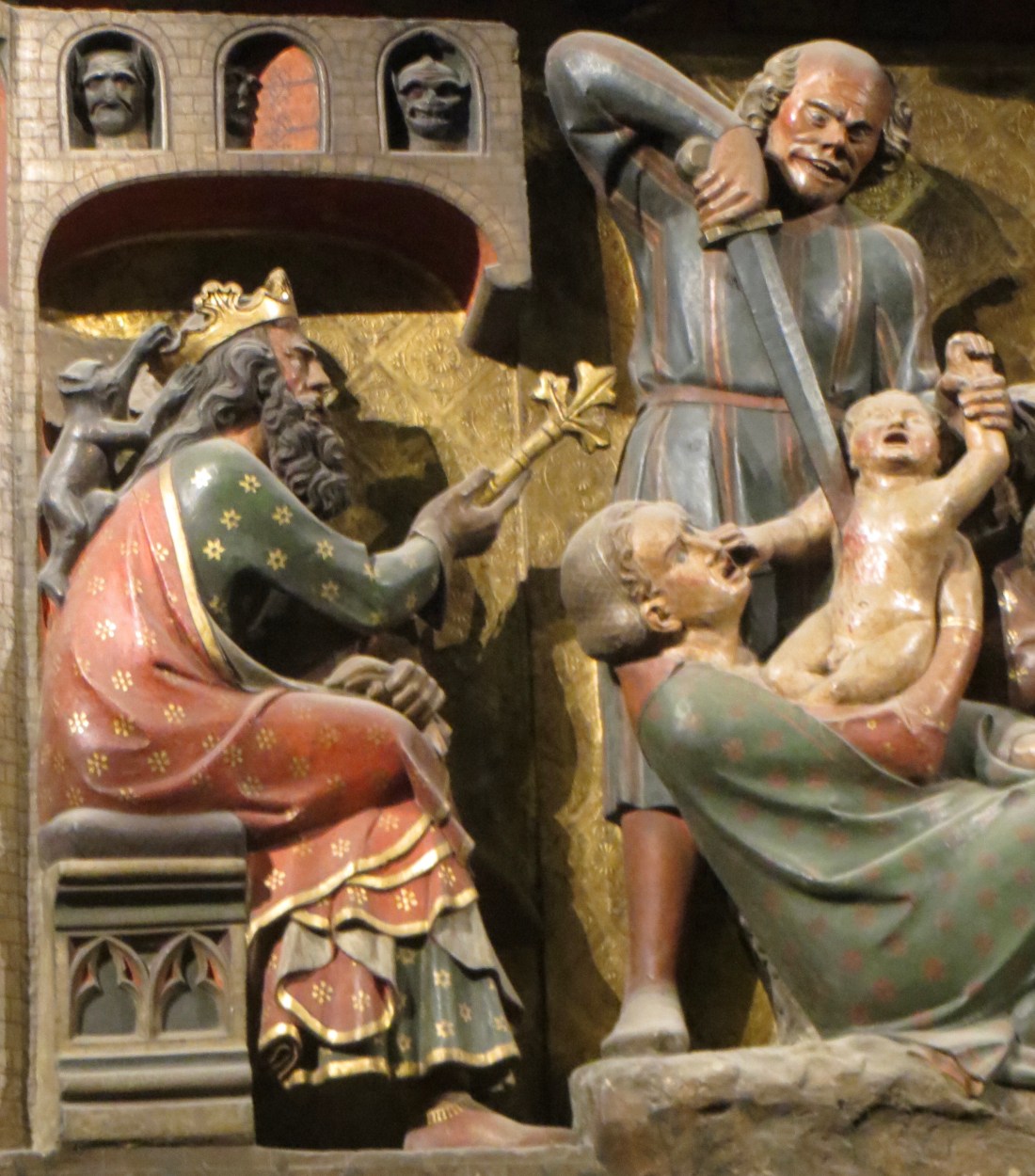
Exquisite 14th c. carved choir screensThe Devil is literally putting evil thoughts into Herod’s head–the Massacre of the Innocents.
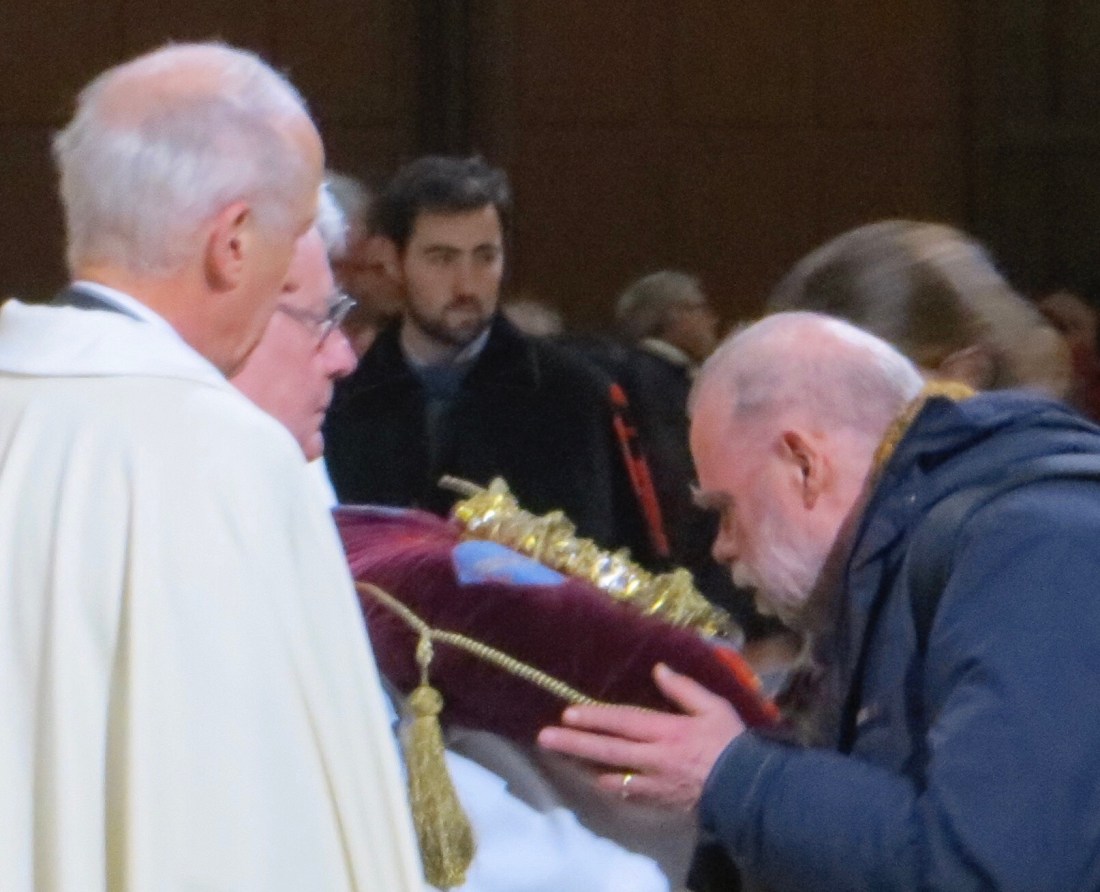
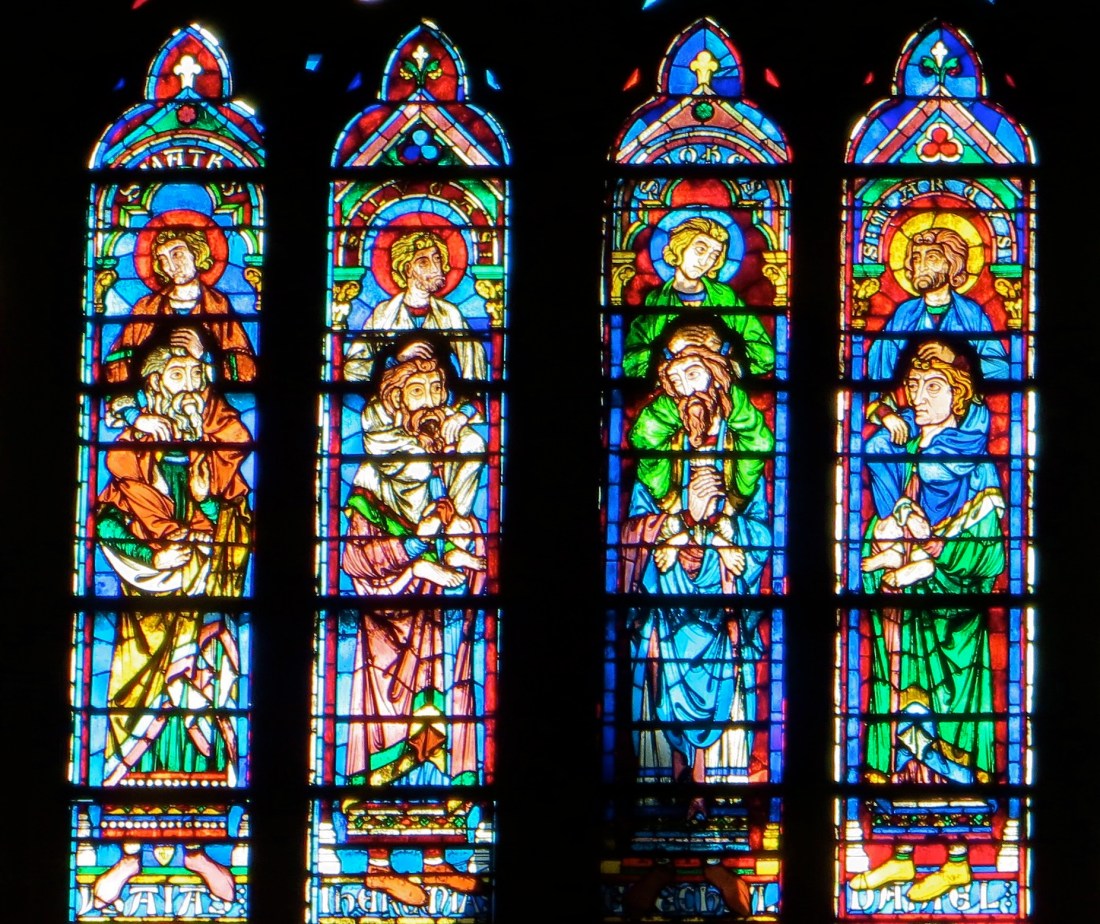
Our friend Jim Forest venerating the Crown of Thorns during Lent 2013The New Testament evangelists see farther because they stand on shoulders of giants, the Old Testament Prophets.
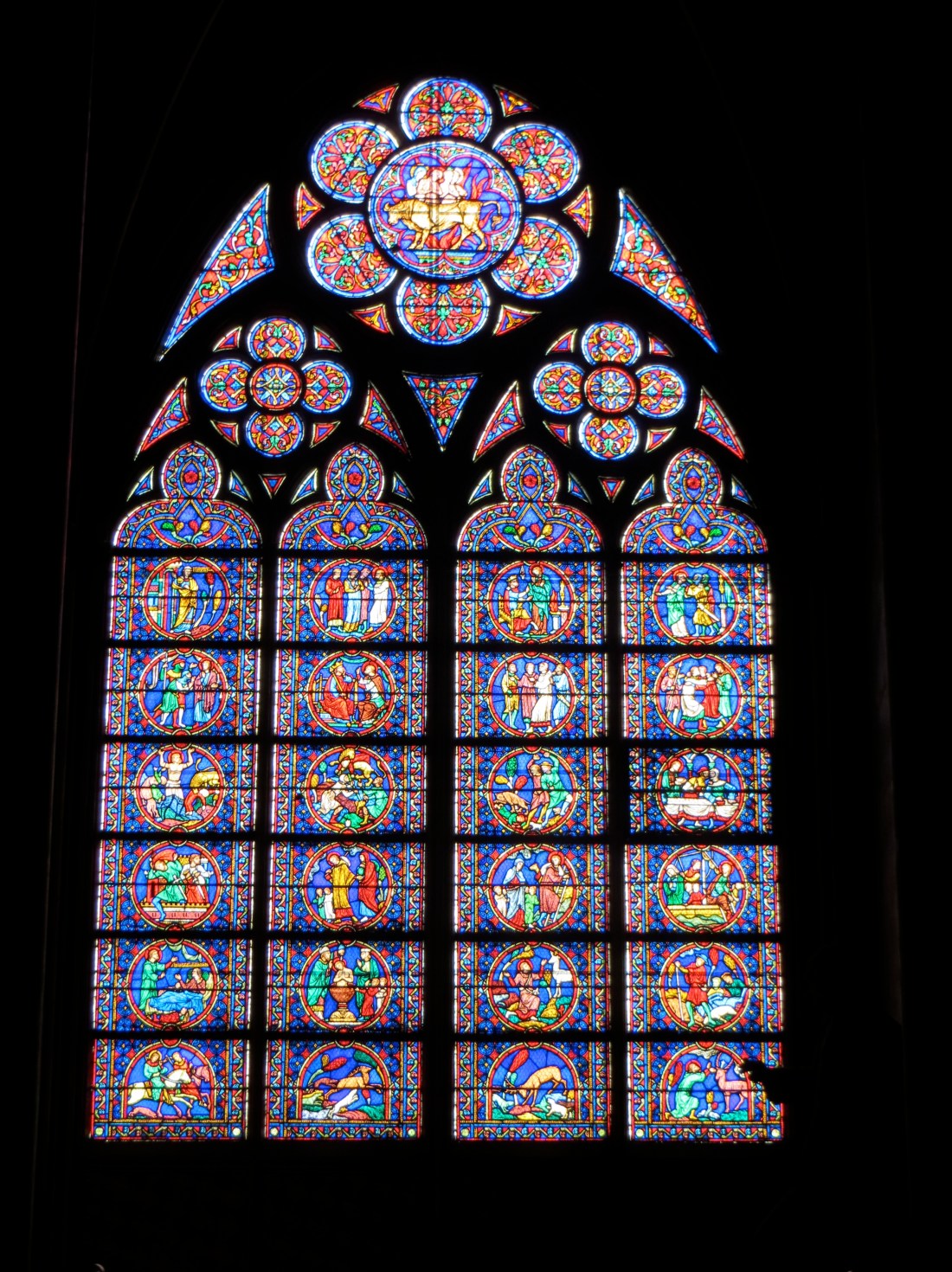
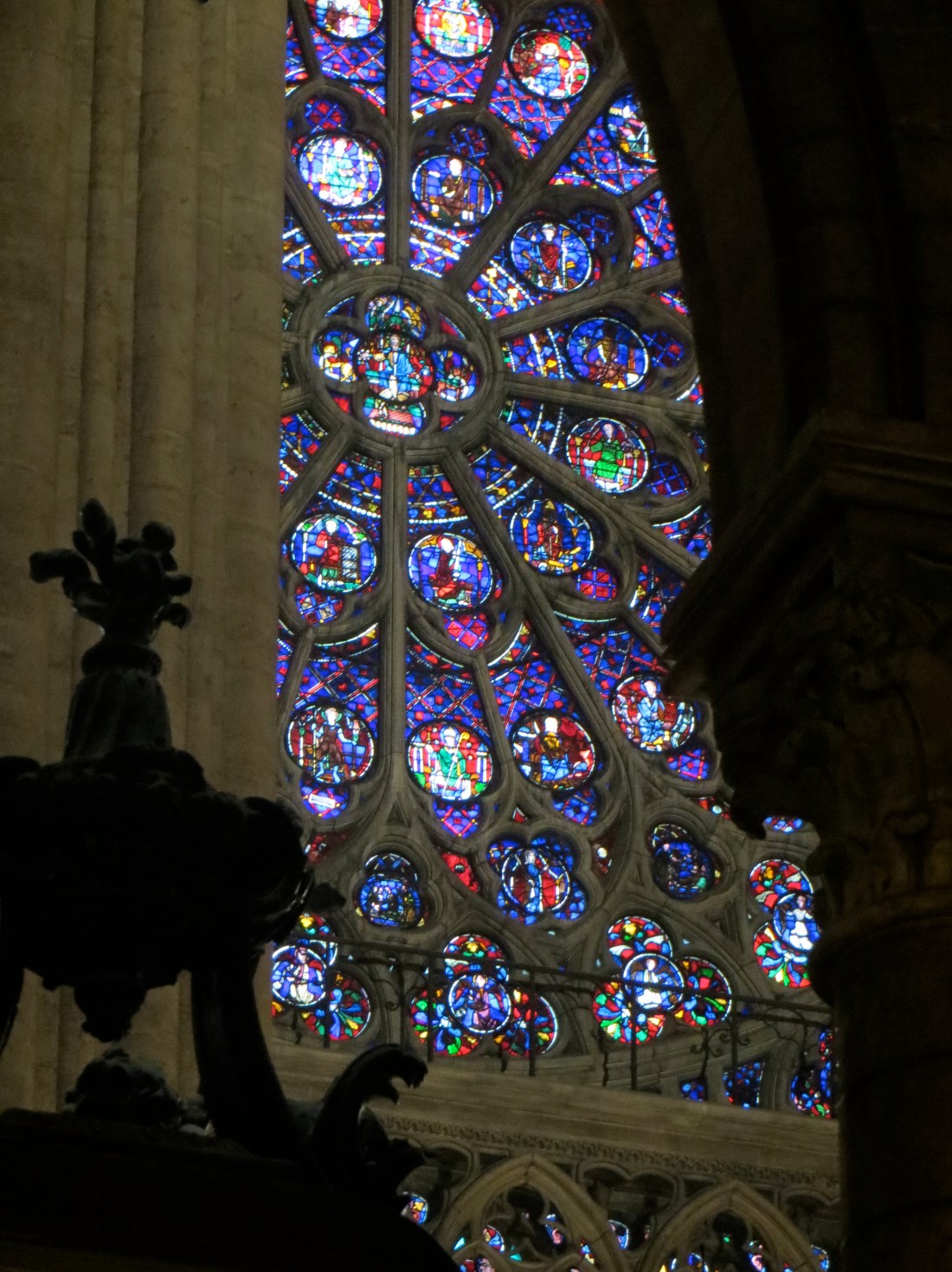
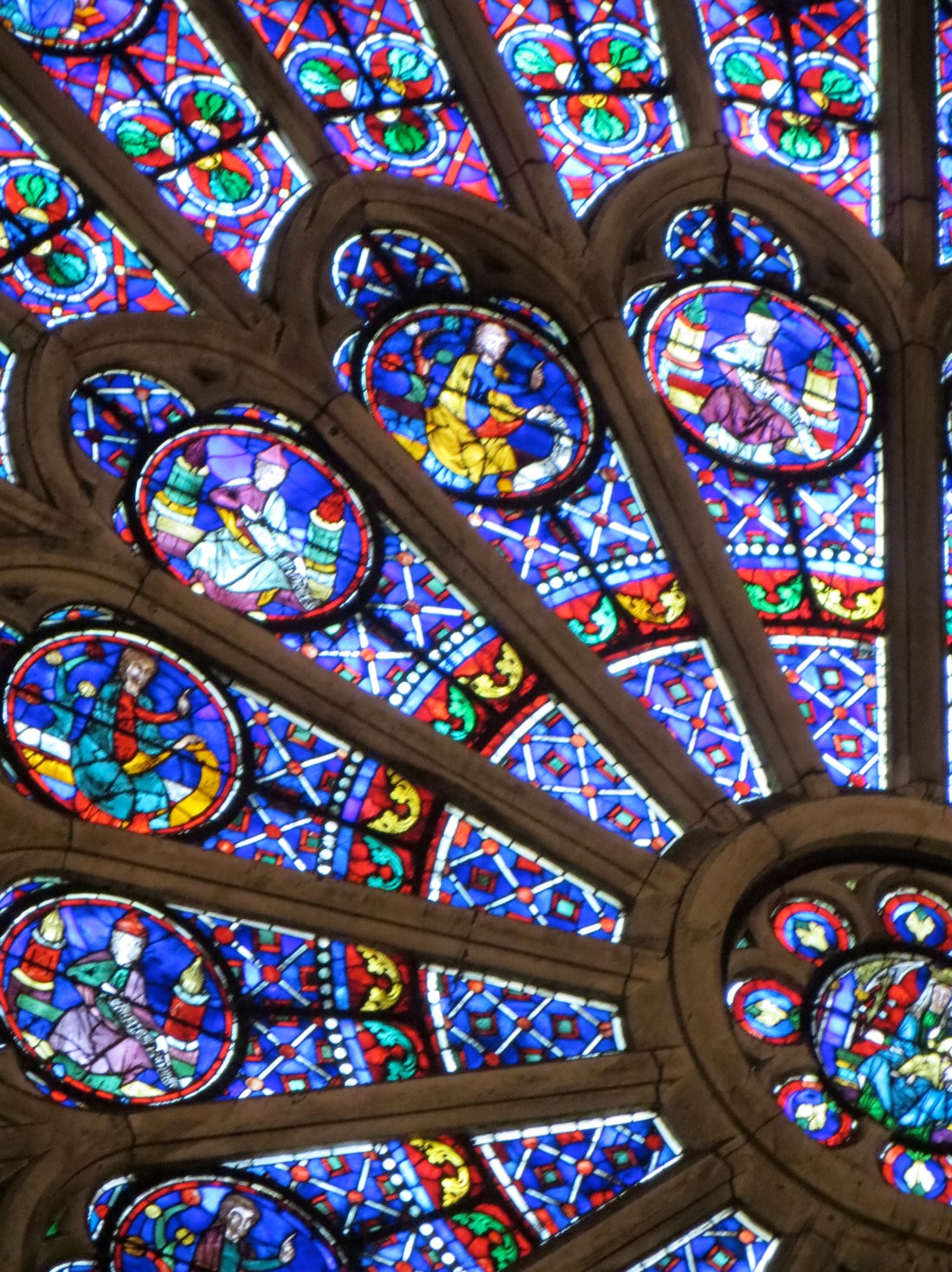
The Rose Windows survived. This north window, donated by King Louis IX (“St. Louis”) in the 13th c., depicts Our Lady at the center surrounded by the kings & prophets of the Old Testament. It has retained more of its original glass–85%– than any other window in Notre-Dame.
We didn’t intend for four months to pass since our last blog post in September, but we’ve been busy! In October we met up with dear friend Betsey Beckman from Seattle, at the megalithic site of Carnac, and then flew to the Netherlands for a delightful visit with our long-time friends, Jim and Nancy Forest. But it feels like most of the September and October were filled with meeting the labyrinthine and Catch-22 requirements to obtain our Carte de Séjour, the residency permit required to live in France longer than three months. While John needed this, Kathleen with her Irish/EU passport did not— except that it eased the way for the next administrative hurdle, signing up for the French healthcare system. We successfully traded reams of translated documents for the Carte de Séjour, the small plastic ID card which we must always have in our possession.
More Catch-22 requirements, not unexpected, had to be met before our household goods could be shipped from Seattle and cleared by French customs. Arriving at our door on the 30th of November, this past month has felt like Christmas every day, opening boxes we’d packed 6 or 8 months ago, rediscovering the treasures we’d sent along to join us in our new life.
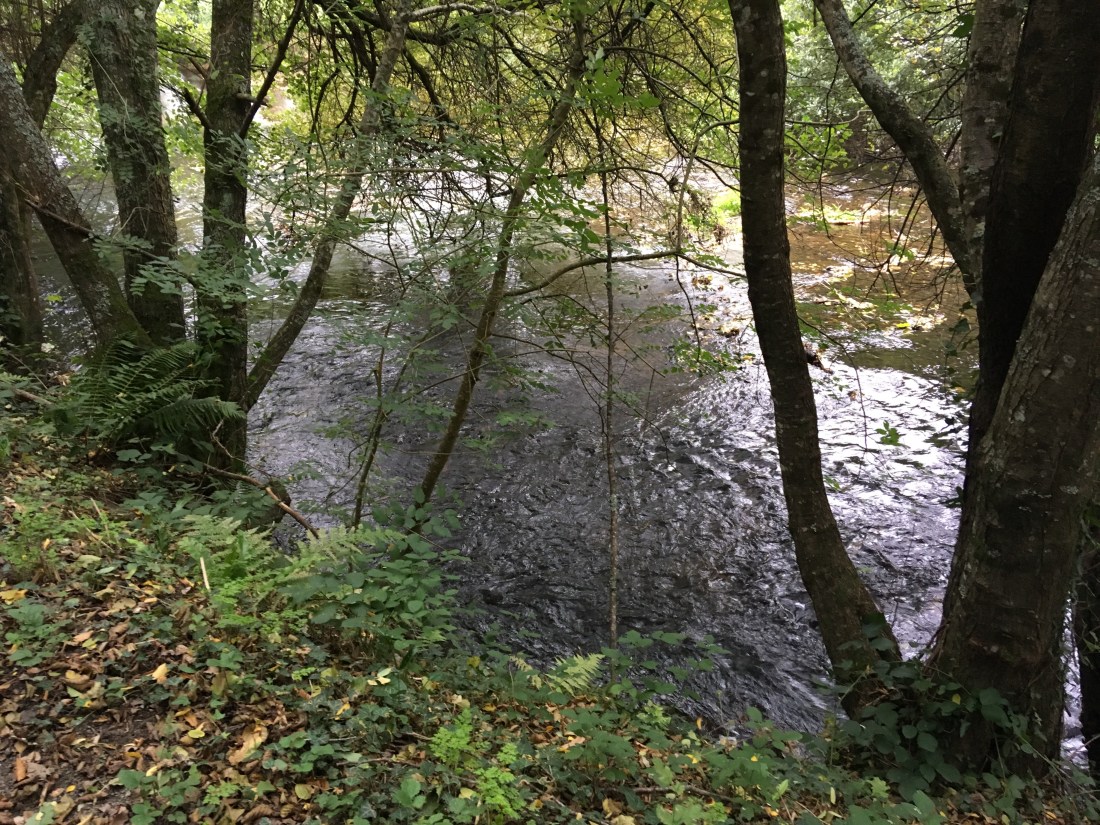
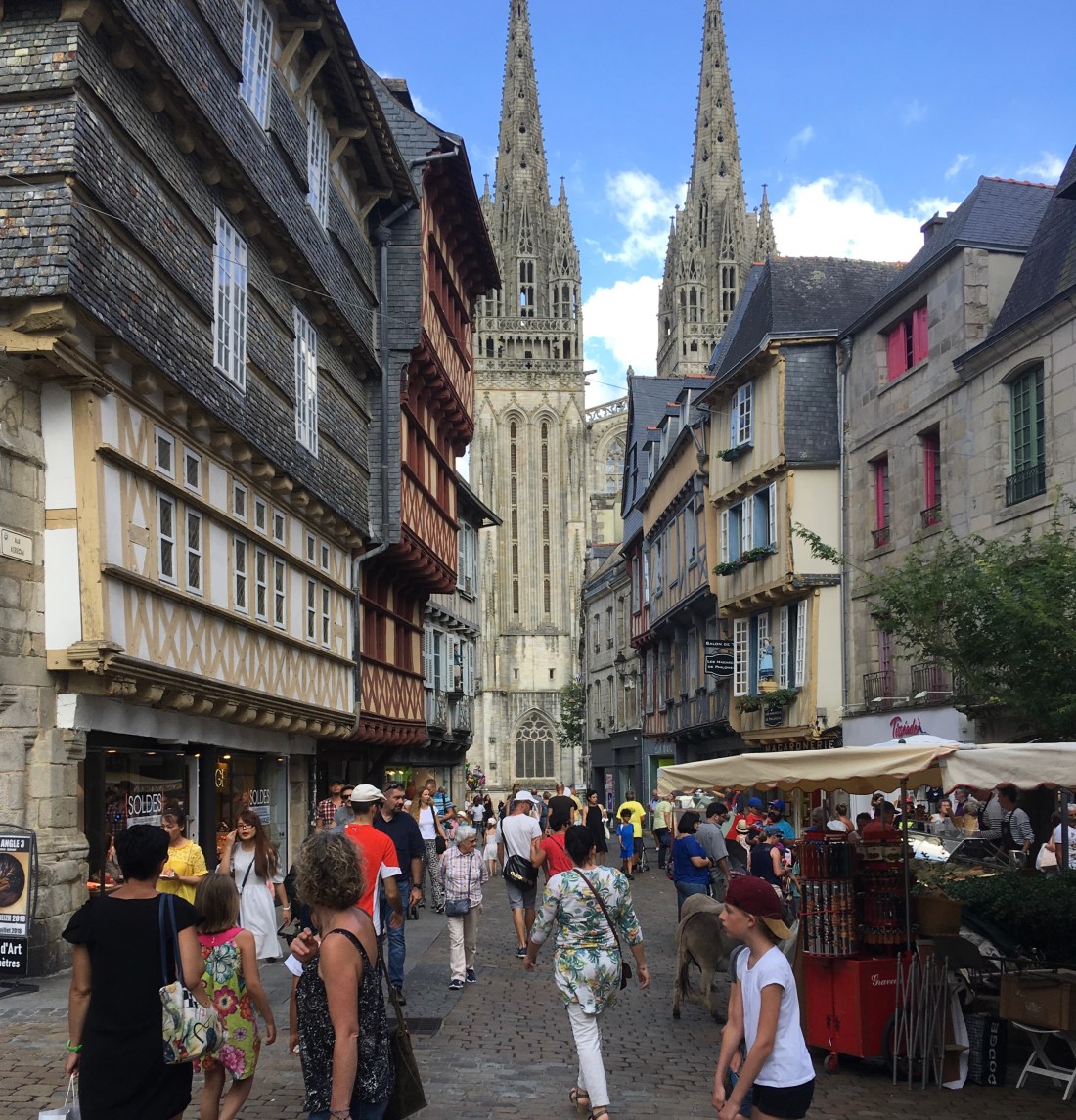
Our town of Quimper is small. With 65,000 people, that’s less than show up for a Seahawks game in Seattle. And the hypercentre where we live—the city centre within the remains of the mediaeval walls—is but a small fraction of that. But Quimper is the cultural as well as political capital of Finistère (the westernmost department of Bretagne and thus of France), and there is always something going on. We’re now members of both the art museum and extraordinary Breton cultural museum.They sit on either side of our church, the mediaeval cathedral of Saint Corentin, eighty steps from our front door. The covered market, the weekly farmers market, and a wooded walk along the river are all but several minutes walk away.
It’s lively here! and if something is happening, it’s probably coming down our cobbled street, whether it’s the protestors called the gilets jaunes (yellow vests) bringing attention to the financial squeeze on the working class, a quartet of jazz-playing Santas, one of many other holiday spectacles, or a religious feast-day procession. We have a front-row seat from our apartment windows. Take a look yourself at this video sampling of December’s street scenes.
Here’s a slice of our life here from a day last week: The morning began with a scheduled visit from our plumber to fix un petit problème. Then our downstairs neighbors invited us to meet their friend, Alain Bodivit, a now 92-year-old remembering his days in the French Resistance during la Seconde Guerre Mondiale (World War 2).
Monsieur Bodivit spent an hour answering our questions and sharing his stories. He was only 17 when he joined a resistance cell to sabotage the German forces here in south Finistère. One story: They used to short-circuit telephone lines by wiring on the A string of banjos! With phone lines down and while figuring out what the problem was, the German occupiers were forced to communicate by telegraph, which was easily intercepted by allied forces. Their cell was sworn never to confront the occupiers directly since that would have resulted in fifty-fold reprisals. The cells were limited to ten members each to thwart infiltration.Nevertheless, three of Monsieur Bodivit’s ten comrades were captured and tortured. They never revealed the other seven and died in concentration camps. We’ve included a short video where he talks about his surprise learning after the war of the participation in a different resistance cell of other young men he’d played soccer with. We were sobered and thrilled with the chance to meet one of those who, in a time of so much collaboration, stood up to Nazism and thus helped save the honor of France.
In the afternoon we headed out for our nearby walk along the river Steir, when we ran into a street theatre troupe working its way down our rueKéréon, setting up a mock-boxing ring, smashing plates, pouring wine for the crowd that followed (yeah, of course us…we support live theatre…) singing rounds of the Italian anti-fascist resistance song Bella Ciao (go ahead, look it up) and just instigating rousing great fun.
While we were preparing dinner, Tarte à l’Oignon, the door buzzer sounded with some friends dropping by on their way to a show. We spent the next hour over apéro, wine and nibbles, talking about the subject that always interests our French friends, as well as ourselves: more food and wine! In particular, the upcoming house-warming party January 5th we’re throwing for over two-dozen of our new Breton friends.
What show were those friends headed to? We’ve been able to watch it out our window these past two weeks: a sound-and-light show on the façade of St. Corentin, narrating in French and in Breton the legends surrounding the Cathedral, the story of its construction, and celebrating the land & sea and cultural traditions of this area. Big crowds have come every night for the spectacle which continues through January 6th—you, too, can watch it via the video we took (give it a few seconds to begin and don’t worry, it will play in portrait mode):
We’ll spend this New Year’s Eve with Gwenael, whom we call our Breton godfather. It was Gwenael’s home exchange offer two summers ago that first brought us to Bretagne and changed our lives. (Note: If it hadn’t been for that second bottle of Champagne, you could have read this post on New Year’s Eve, as we intended…)
A dear friend wrote the other day sharing her happiness that we are “living our dream.” But, to be honest, this is so much more than we dreamed. There’s an obscure line in Jane Austen’s Pride and Prejudice that we used on our wedding invitation nearly thirty years ago and still always seems apt: “They were all intending to be surprised, but their astonishment was beyond their expectations.”
We’re having a ball and wish you could join us. Some of you have threatened to visit us next year or so, a thought that delights us. (July is already looking pretty booked up….) In the coming month, Kathleen promises another post—this time a tour of our new little home, just to further entice you.
Last New Year’s Day, our resolution was to move to France…that worked out pretty well (better than resolving to floss more often). We are enormously grateful for all that 2018 brought us.Our prayer for 2019 is this: That peace will grow in small and in large ways, all throughout the world.And that you, too, may dare to take steps to realize the dream or dreams you have held!
We end with a few pics of some of our experiences this autumn…
(This post written by Kathleen, who takes full responsibility for any factual errors.)
(Tap on a photo to read the caption!)
For John and me, the second week of August was a three-festival-, two-fireworks-show-week!And it happened to coincide with my birthday.
Doubtless there is a festival in multiple places in Bretagne every day of the summer.As in Seattle, where the climate is similar, the Bretons make as much hay as they can during the few months when the sun shines (and the weather is warm).Summer is one long season of festivals—of music (traditional, jazz, classical, rock, world), of boats and sailing ships, of giant photos mounted outdoors, of food (a favorite obsession in France).Religious feasts of the patron saint of a village, church, or chapel.Original and unusual festivals, like the one we went to on the Fête Nationale (Bastille Day) last year which features a “course aux lits”—a race in which the participants are mounted on bed frames on wheels and race to the finish line.There is even a Festival of the Crêpe, which includes a competition for making the world’s largest crêpe!
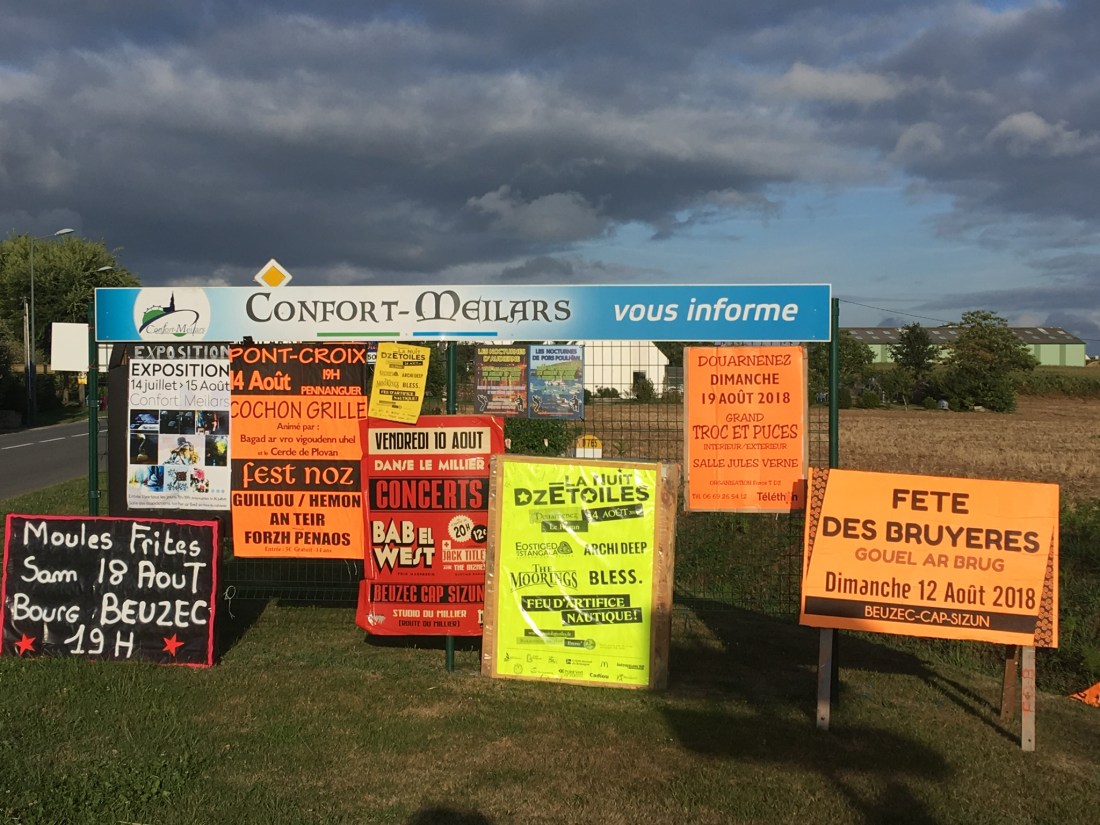
Posters & announcements for festivals & events abound at crossroads…this is one cluster from mid-August
And apparently Parisians are envious of the Bretons & their festivals, which all, from tiny village Fest-Noz (nighttime celebrations) to big multi-day, multi-stage music concerts, are exclusively organized and managed by Bretons themselves—not an outside promoter or festival organizer.Each festival is joyfully staffed by hundreds of volunteers, thus investing locals in the pride of their celebration.
Though there are a multitude of themes, for many festivals the heart-and-soul is a celebration of local Breton heritage and culture, a culture which has seen a renaissance in the last 4 or 5 decades.The Breton language was banned in schools until 1951, and we have spoken to quite a few older adults who never learned the language of their parents, and thus didn’t pass it on to their children.As with many regional minorities, the Bretons are claiming and reclaiming their distinctive culture and their language, even as the French government resists giving support to regional languages such as Breton, Basque, Alsatian, Occitan, Catalan…(France has not been able to ratify the 1992 European Charter of European and Minority Languages, due to a constitutional issue but also due to an ideal held by many lawmakers of “one Republic, one language,” which dates back to the Revolution and sees minority languages as a threat to French cohesion.But that is a subject for another post…). “Diwan” schools (both public and private) are flourishing, teaching an all-Breton or bilingual Breton-French curriculum to a new generation of children.The festivals are an occasion for artisans to introduce and proudly display their traditional techniques, for young and old to parade in costumes specific to each village, for musicians to play the traditional Breton tunes and dancers to demonstrate the traditional Breton dances.
This slideshow requires JavaScript.
For us, a highlight of the festivals has been the Fest-Noz, these outdoor nighttime celebrations where bands play a musical hybrid, combining traditional Breton tunes and/or instruments—the biniou or bagpipes, the accordian, the bombard which is a high-pitched reed instrument in appearance like a small oboe—with guitar, bass, drums and contemporary rhythms of rock or blues or jazz or funk.People of ALL ages gather to join in the traditional dance forms, many of them circle dances or line dances which snake and weave and undulate, where the participants join pinkie fingers and pack the dance floor!Even if you don’t know the dance steps, you are welcome—just link your pinkie to the closest person and do your best to follow along.Many of the simple line or circle dance steps date to the Breton agricultural communities of the 19th century or earlier, when everyone would come to together to pound the earthen floor of a new home, or to prepare a threshing floor.Today’s Fest-Noz seem to us to be a joyful, inclusive celebration of Breton culture, an identity that you are born to but that you are also welcome to choose to enter into.(That would be us!).
Fest-Noz at the Festival de Cornouaille in Quimper
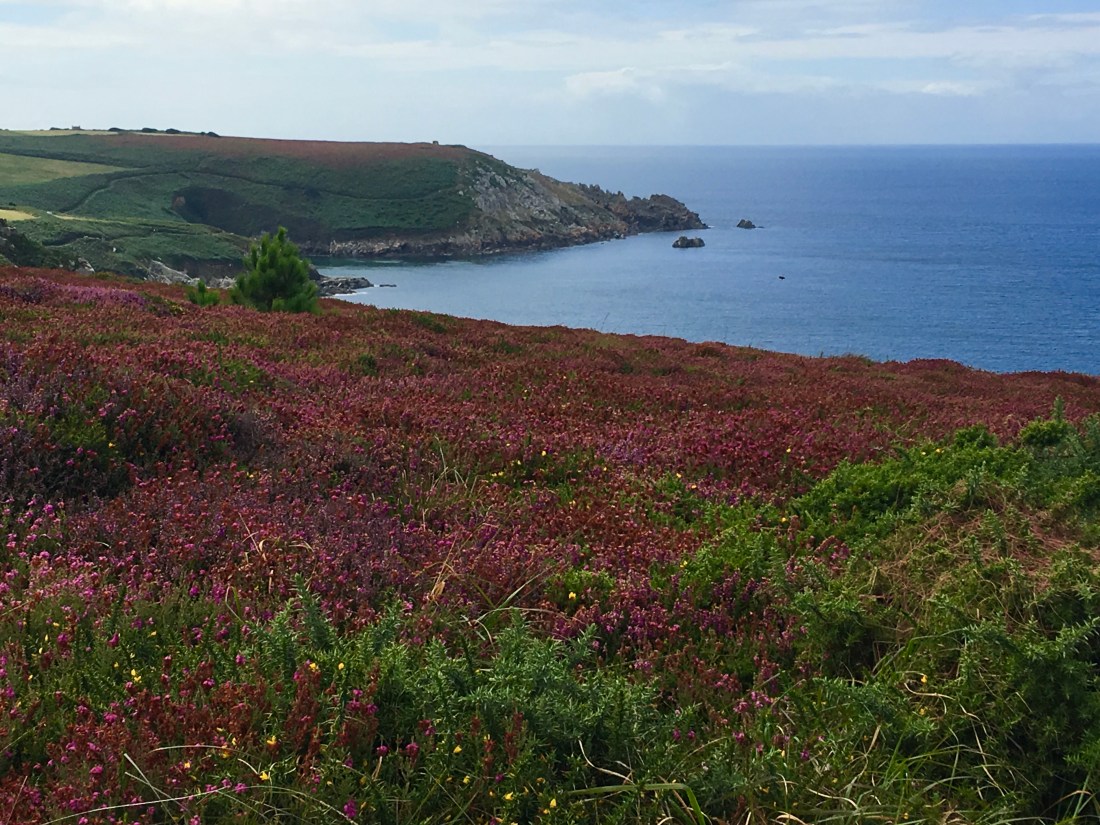
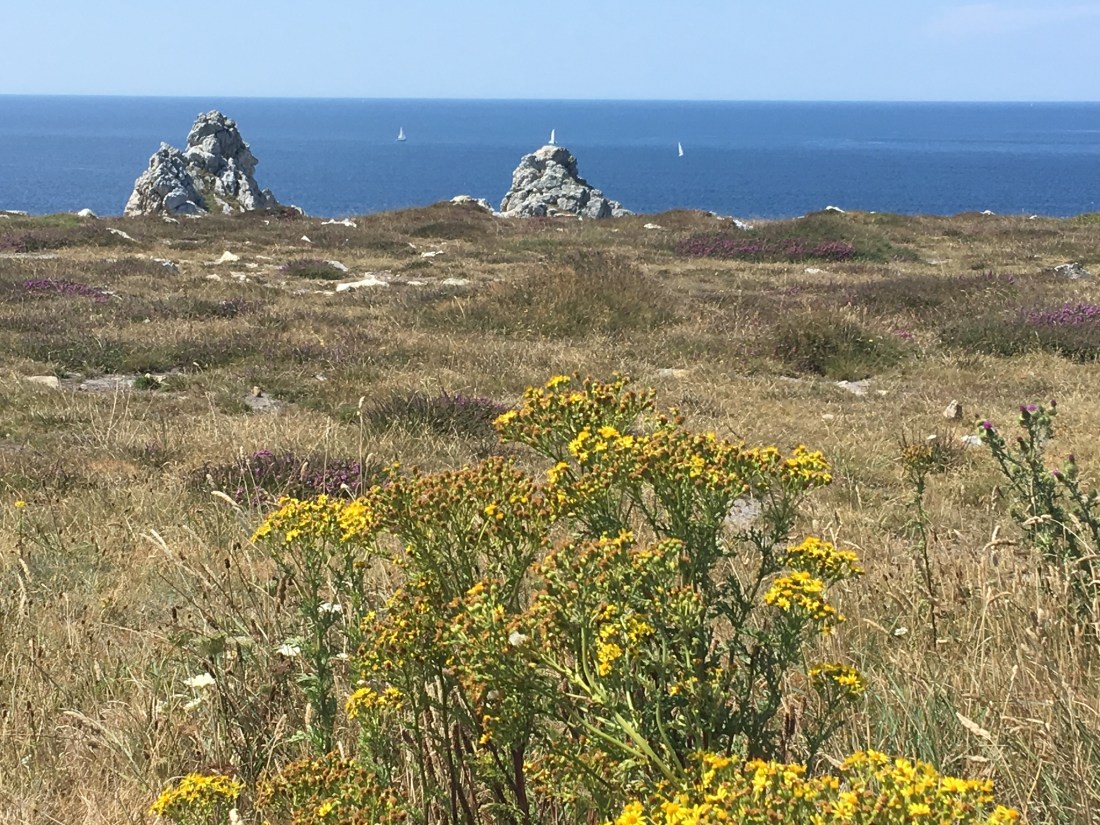
The ultimate experience of Fest-Noz for us this summer was the closing of the Fête des Bruyères—the Heather Festival in Beuzec-Cap-Sizun, on the north coast of Cap Sizun, where fields of pink, mauve, and sometimes orange heather bloom right down to the cliffs overlooking the sea.
Fields of heather at Beuzec-Cap-Sizun
It rained that day—the opening parade came off without a hitch, and many of the traditional dance and music groups were able to perform…
This slideshow requires JavaScript.
….until the skies opened and the rest of the afternoon program was scuttled. A long break for the thousand or more people attending to line up at the food booths for mussels with fries or sausages (more than half of French pork comes from Brittany) with fries, for crêpes or kouign amann (literally, “butter cake,” whose name you understand after one bite).Later that night, the Fest-Noz began, and so did the rain, again.But the throngs, of all ages, filled the huge outdoor festival space, dancing to song after song after song under sheets of rain, laughing and smiling breathlessly, enthusiasm clearly NOT dampened, even if they were.(Seattleites would fit right in.). A celebration of pure JOY.
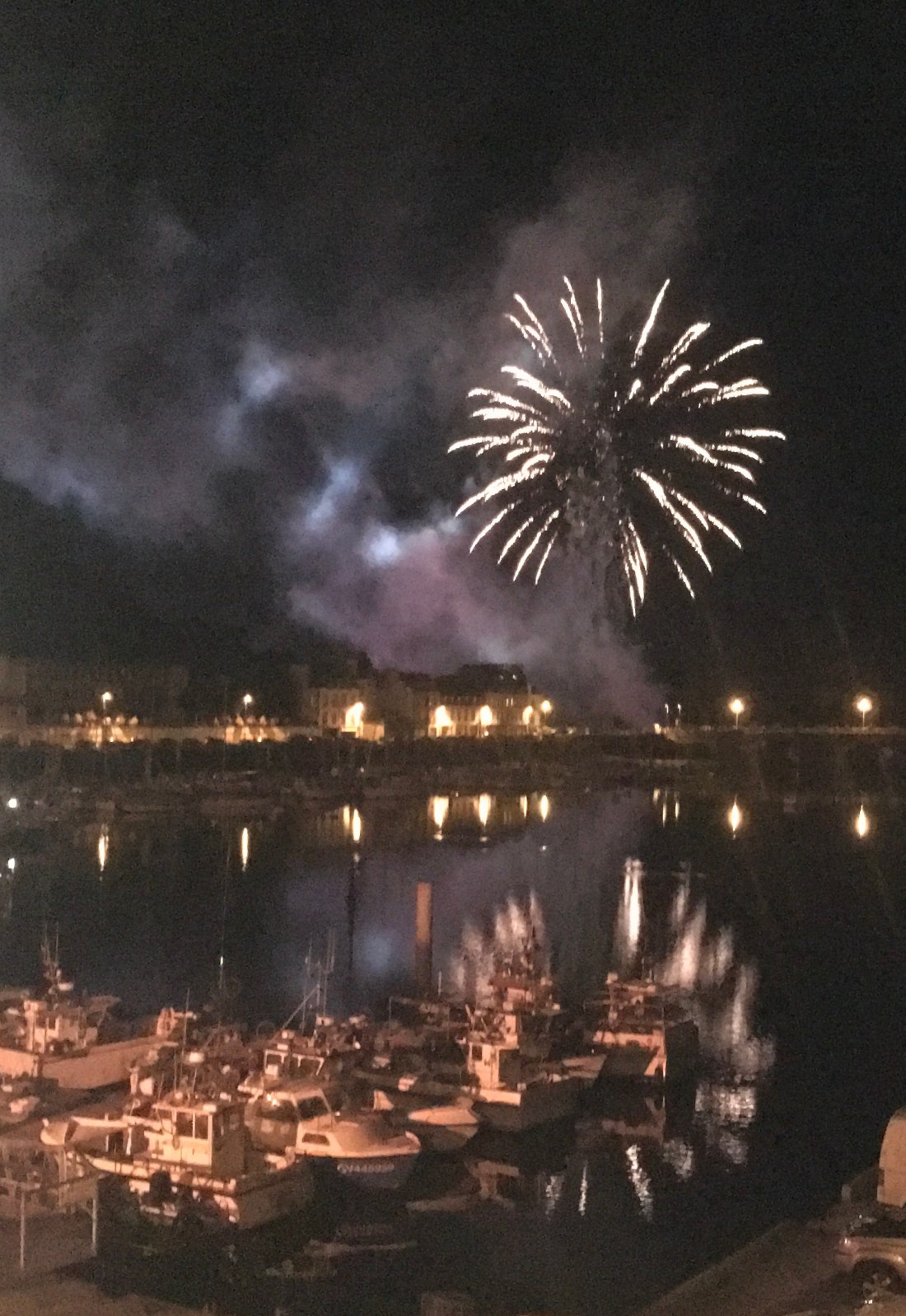
And when the rain stopped, at 11 pm, there were fireworks.Seems they are requisite at any festival worth its crêpes.At the Poissonade (an outdoor seafood fest) in the small town of Primelin—where you could buy soupe de poissons for 3.5 euros, mussels or grilled sardines for 4, and John and I had fish kebabs for 5.5 euros — the concert of Breton rock was followed by fireworks over the bay, in the same sky where we had earlier watched the quartet we’d been following all month:Venus setting, and Mercury rising, and Jupiter and Saturn twinkling in between the two.Magical, all of it.(I always wanted a fireworks show for my birthday…)
At the PoissonadeFireworks over Audierne
*****
And now it is the end of the festival season.Summer is officially over today, the day of la rentrée, everyone back to work and to school.We have been quite itinerant this festival season—yesterday we moved to our 11th lodging since we arrived in France 8 weeks ago. (We’re a bit impatient for October, when we can begin moving into our apartment in Quimper…) August was spent in Cap Sizun, in and around the town of Audierne. We LOVE Cap Sizun, with its wild coastline alternating with pockets of clean sandy beaches; and Audierne, a maritime capital since Roman times, in the 19th century a sardine fishing center until the sardines up and left for waters further south in the early 20th century. It is still a fishing port, and we enjoyed watching the boats depart in the early morning hours, returning in mid-afternoon or later with their catch. Increasingly Audierne welcomes pleasure craft, as well as French (and many German) families vacationing, with water sports for everyone—splashing, sailing, surfing, windsurfing, stand-up paddleboard, kayaking…
Port of Audierne
Port of Audierne
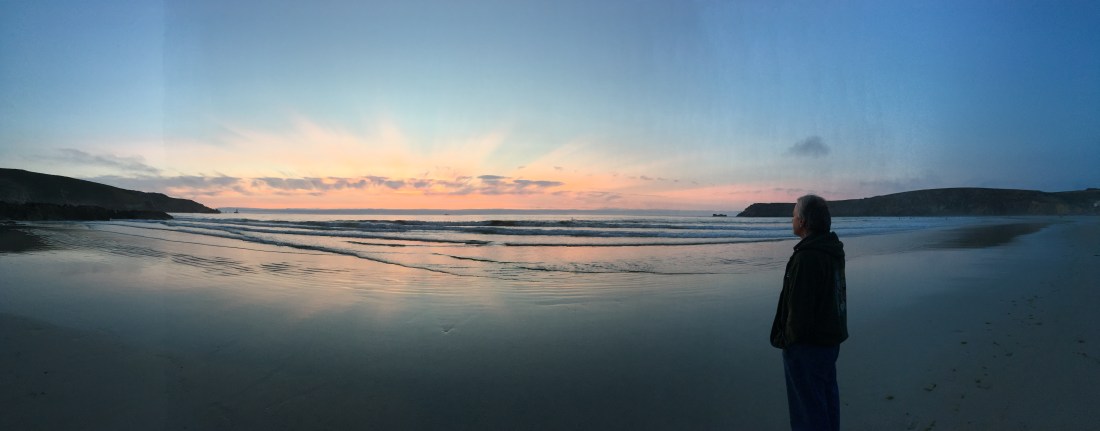
John on the beach of the Baie des Trépassés at sunset
“How do you spend your days?” is a question we’ve been asked.
Think of a fireworks display, how you can watch the ascent of each rocket, without knowing what it will open into, curiously awaiting each “ooh” and “aah…”.In general we start out with an idea of the trajectory of a day, but we stay open to whim and whimsy and allow the day to answer to our needs & desires. John and I walk, along the quai or the coastline or river or field.We visit the tiny medieval and baroque chapels which dot the countryside.We go to festivals!We explore towns and villages and hamlets, taking any road that strikes our fancy, discovering sweet corners of beauty and charm.We delight in the market days (Saturdays in Audierne) when the bounty of the region is available—fresh produce, cheeses, ciders, baked goods, honey, roasted chickens, prepared dishes, specialty foods—at prices that are affordable.We try to engage with everyone we meet and the connections delight us.
Chapel of St. Brigid, Esquibien
The River Goyen
Wall in Pont-Croix
Church in Esquibien at sunset
Trail GR34 in Cap Sizun
At Beuzec-Cap-Sizun
I had always lived in big cities (well, except for that JVC year in Great Falls, Montana), and had never experienced the personal scale of small-town life.In addition to deepening a handful of existing relationships, already we have crossed paths with numerous people we met last year, people who have made us feel welcome, who remembered us (Americans are a rare breed out here in the wild west of Bretagne) and are tickled that we have actually made the move we talked about with them last summer!We have only one rule that supersedes any plans we may have made:Accept every invitation that comes our way.As much like a fairy-tale this place and this beauty may seem to us at times—pinching ourselves to check if this is all actually REAL—it is the connections that we treasure.Our lives have always been about community, and we seek and hope for those riches here, too.We are blessed already to be meeting interesting people and building friendships.And I am ABSOLUTELY THRILLED to be doing it all in French, my first true love!
Contemporary take on traditional dance by Quimper dance circle
“In Brittany people are slow to warm to you.”“The Bretons are a reserved people who are sometimes seen as cold—at first—but who, once they feel sure of you, will welcome you into their hearts.” Or so many Bretons have told us about themselves. We have now been in Finistère, the westernmost department (like a county) in Brittany, for 2-1/2 weeks, and we haven’t felt a whiff of a cold breeze.There is warmth everywhere we turn, in connections already-made in past years which are becoming true friendships, and in new encounters and acquaintances and the conversations which happen every day.
It began the day of our arrival, greeted at the Brest airport after a long 17+ hours of travel by the bright face & enthusiastic welcome of Marie-Louise.We had met M-L and Alain her husband for a brief 2 hours last summer, interested in a possible future home exchange with them.They opened their home in Landerneau to us for the first 2 days of our Adventure, feeding us and housing us and setting the tone of gracious hospitality and warm welcome for all that has followed.M-L helped us pick up our car, and thanks to her we haveFrench cell phone plans.(To open an account with one of the major cell service providers—rather than the kind of service we bought last year at a big-box store, which had poor coverage out here in the wild west of France—you have to have a French bank account. Which we don’t, yet. And we will face challenges opening a bank account, because to do so you have to have proof of address, like a utility bill. And to have an address, whether to buy a home or rent an apartment, you have to have a bank account. This is what we call a vicious circle, or a catch-22, and what the French call a boucle, which means “curl.”). M-L added us to her cell phone plan until we can establish our own!
Our first wheels in Bretagne!
A couple days later we celebrated our 2-year anniversary of friendship with Gwenael, whom we call our “Breton Godfather.”In 2016 we were looking to re-visit the South of France, and it is due to his out-of-the-blue proposal to exchange homes with him that we first visited Brittany.And fell in love—a coup de foudre, like a lightning strike, love at first sight.We had a lovely lunch in his garden where it all began, and learned more about Breton identity and the Breton language and the struggles with the government to retain it and teach it.Gwenael, a native Breton and fluent in the language, teaches history & geography in a high school, in Spanish, and is fighting for permission to teach in Breton!He showed us around some more of his favorite towns and beaches on the south coast of Finistère…as we continue to gather information and listen for that whisper of place that will call to us and say, this is where you want to be…
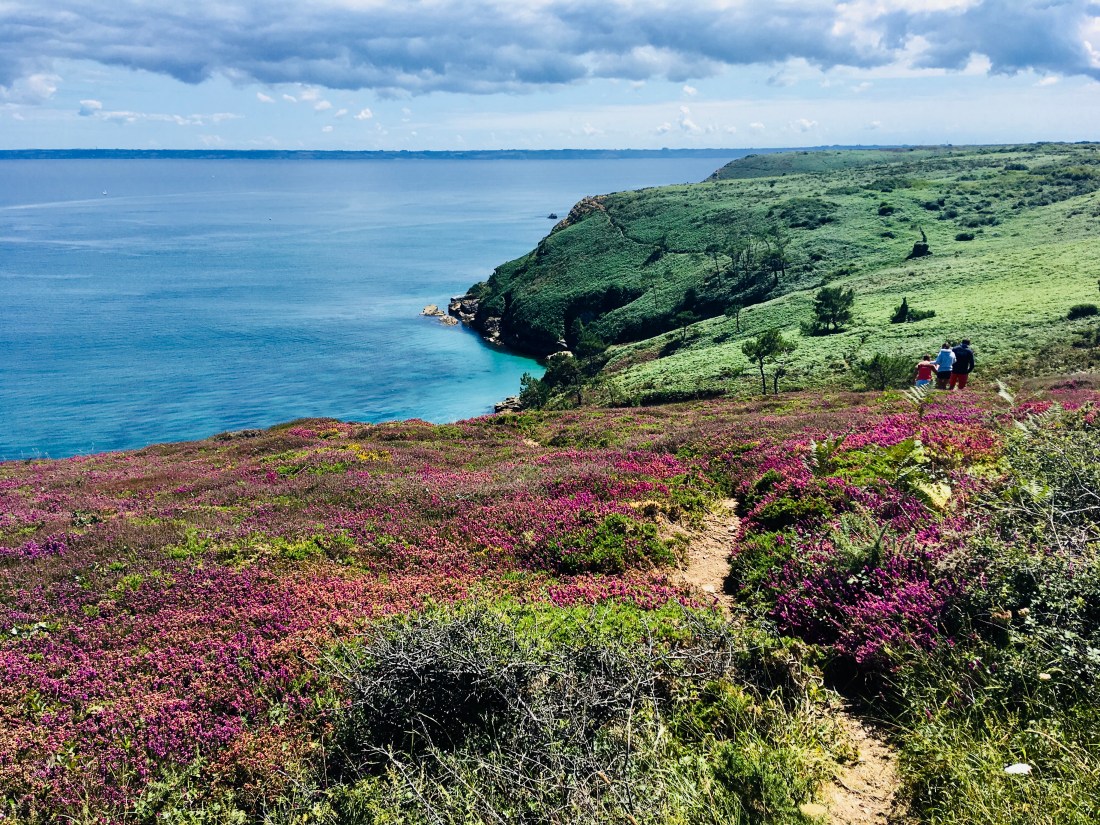
A few days later we moved on to the Crozon Peninsula, wondering if that might be the part of Finistère that calls to us.A week in Françoise’s AirBnB apartment, with a view over the Bay of Douarnenez and a 2-minute walk to the beach, gave us a chance to finally begin to REST after the past 3 months of labor, sorting and clearing and cleaning and letting go and ticking off tasks on a checklist.(Kathleen had 5 nights of packing anxiety nightmares—finally “un-packing” all the built-up stress!).The Crozon is rugged coastline, reaching out into the Atlantic from the western edge of Finistère, with a wild and searing beauty punctuated by stretches of clean soft sand beaches.
Cap de la ChèvreCap de la Chèvre
It makes for an unforgettable visit—but probably not the place for our home, isolated, far from medical facilities (one must think of these things…), and pretty much dead during the off-season.Yet what a welcome!We had some lovely connections with 3 artists in Camaret-sur-Mer, at the western tip of the Crozon.(One of them has a corner of works in his gallery for “pay-what-you-will,” a fascinating experiment that draws in people who normally can’t afford to buy art works…and bargain-hunters…and children wanting to buy a gift for their parents!). And Françoise, a professor of music who is lively and sociable, took an interest in us and we in her, and we shared an evening of conversation & laughter, and ended our week in Crozon gifted with a bottle of champagne and an invitation to stay with her in her flat in Paris!
One place in Crozon particularly captured our hearts:Landévennec, a village on the Aulne River estuary as it meanders into the deep long harbor of Brest (the Rade of Brest).On this sheltered site surrounded by wooded hillsides, the Breton St. Guénolé founded the first monastery in Bretagne in the 5th century, modeled after the Celtic monastic tradition.At the request of the Carolingian emperor, the abbey became Benedictine in the 9th century, was destroyed by Vikings a few decades later, rebuilt several times after raids by the Normans and others, and finally fell definitively during the French Revolution (as was the fate of many churches throughout France, the power of the Church being intertwined with the power of the monarchy).We visited the picturesque ruins, the engrossing museum attached to the old abbey, and the new Benedictine monastery founded 65 years ago on the hillside above the old.There is a peace that envelops the entire village, a quiet beauty far different from the breathtaking views along the Crozon coast, but equally enticing.
Abbaye St. Guénolé
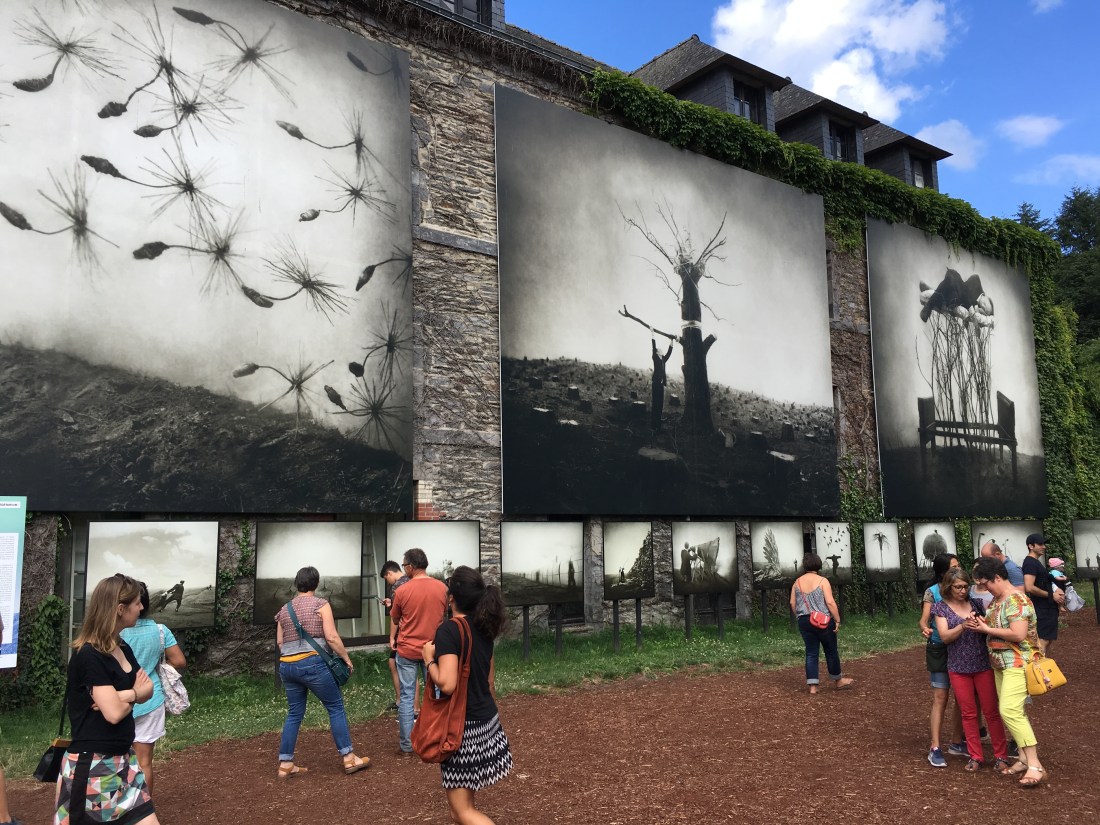
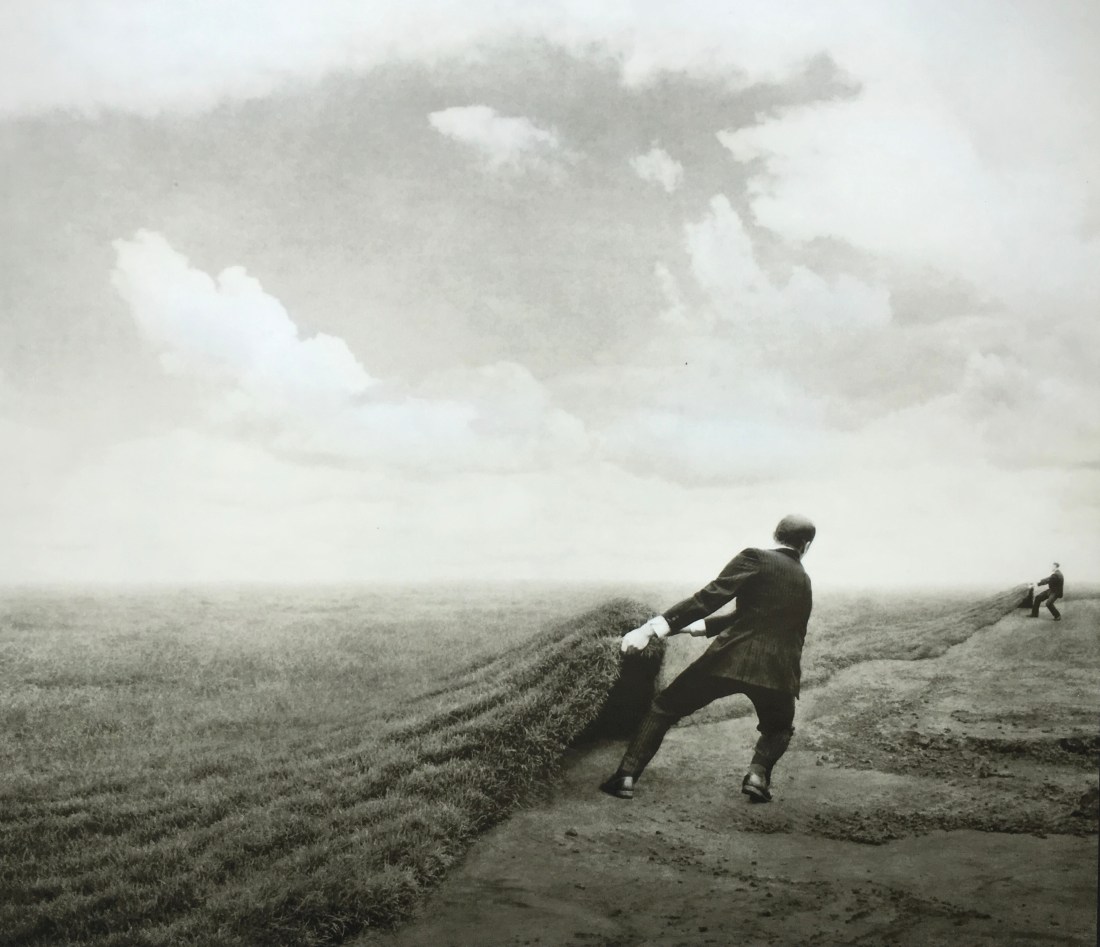
Community having been important to us our whole lives, we have abandoned Kathleen’s original notion of moving progressively down the Finistère coast from north to south, exploring each micro-region in a somewhat methodical manner.Better to follow connections we make with people here!Thus we were thrilled to accept an invitation from our “Breton Godmother,”Emmanuelle (who traveled to Seattle w/Gwenael in 2016), crossing the whole of Brittany from West to East (a 3-hour drive) to spend several days with her in her restored 1812 stone home in a tiny rural hamlet near Bain-de-Bretagne, south of Rennes.We spent a day at the annual Festival of Photography, which takes over the entire charming village of La Gacilly for the entire summer, with 30 immersive outdoor exhibitions mounting large photos around the theme of La Terre—inviting people to think about the fragility of our planet and its future.
Photo installation by Shana and Robert ParkeHarrison
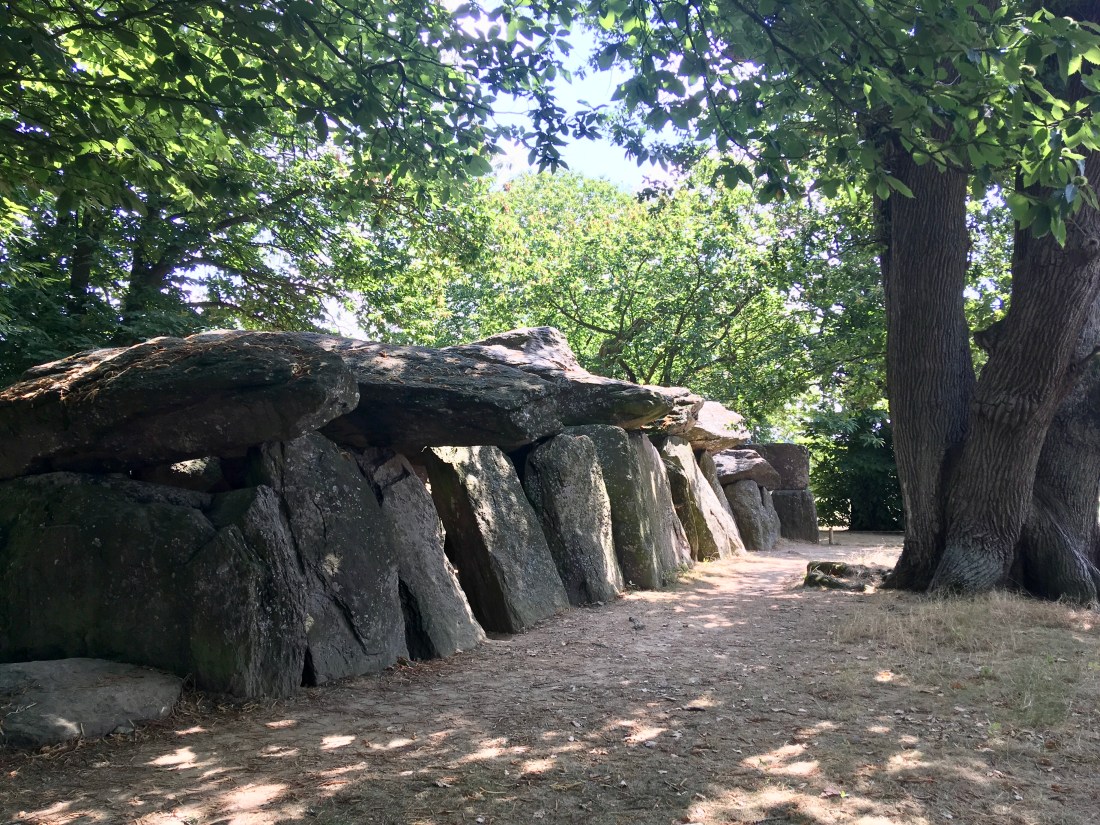
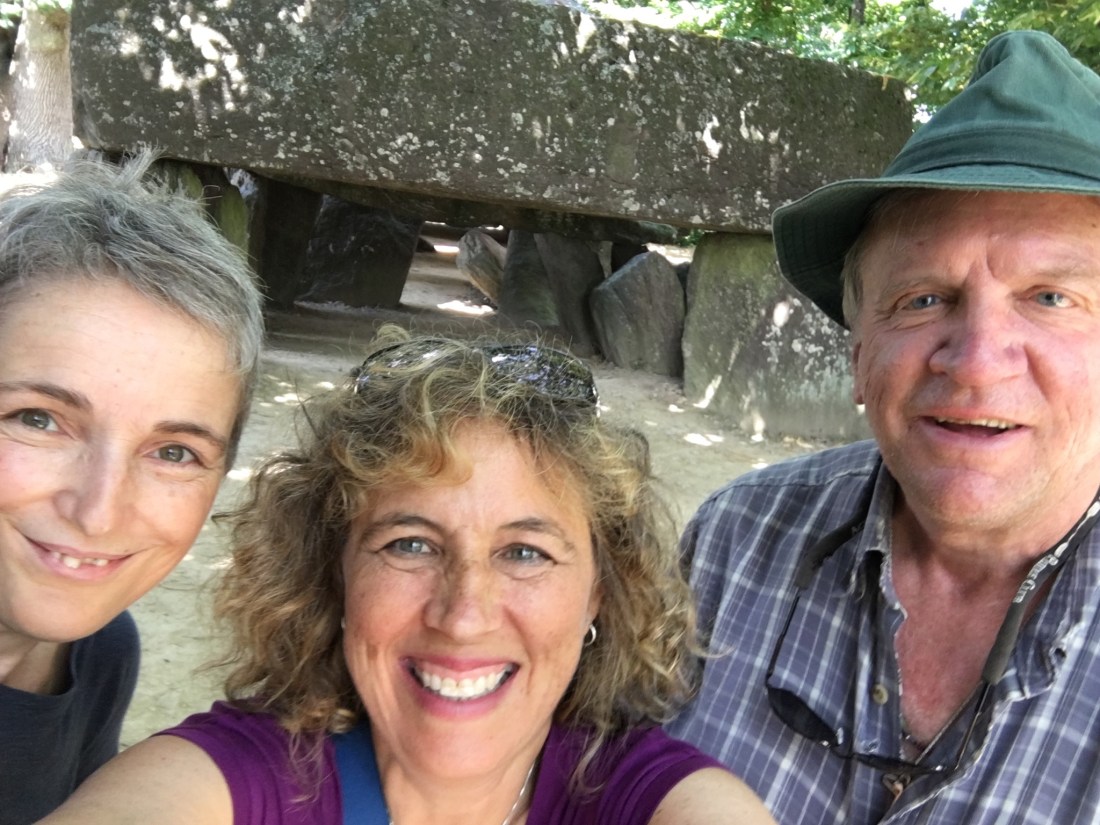
We visited La Roche aux Fées, a megalithic dolmen dating back 4,500 years, which was used as a burial site or “passage tomb” by our prehistoric ancestors.It was originally built up into a tumulus like the site at Newgrange in Ireland, covered with earth and smaller stones.
La Roche aux Fées (Rock of the Fairies, who according to a legend created the dolmen in one night!)
Emmanuelle works in and teaches marketing and product development, AND runs a bed-and-breakfast at her home.She is intelligent and good-humored, reflective and engaged in world and local events. And she is terrific cook who learned to make crêpes from her mother, and gave us a lesson! We are delighted and privileged to deepen our friendship with her!
With Emmanuelle at La Roche aux Fées in eastern Bretagne
Oh, and in that first week after our arrival we were also welcomed by the Tour de France as it came through the small town of Cast (where we gathered with lots of families come to cheer on the cyclists), and by the French soccer team winning first the semifinals and then the World Cup Championship!
But the most amazing gift we have saved to tell you about last:The ideal apartment has dropped into our laps, and only days into our life here!Evelyne is a warm and lovely woman in whose AirBnB we stayed for a week last year in Quimper.It was a perfect location, in the hyper-centre of the historic heart of Quimper, 80 steps from the doors of the Cathedral.During that week we visited over an apéritif, in Evelyne’s own apartment one floor below the AirBnB rental, and she drove us to the airport.We stayed in touch a bit over the winter and spring.Two days after our arrival, she sent an email saying that she wished to welcome us to Bretagne, and also, by the way, “I’ve bought a house in Pont-l’Abbé and I’m putting my two apartments up for sale.”Her apartments went on the market that very day, we visited her 2 days later, and we’re now, already, beginning the process of buying her apartment!
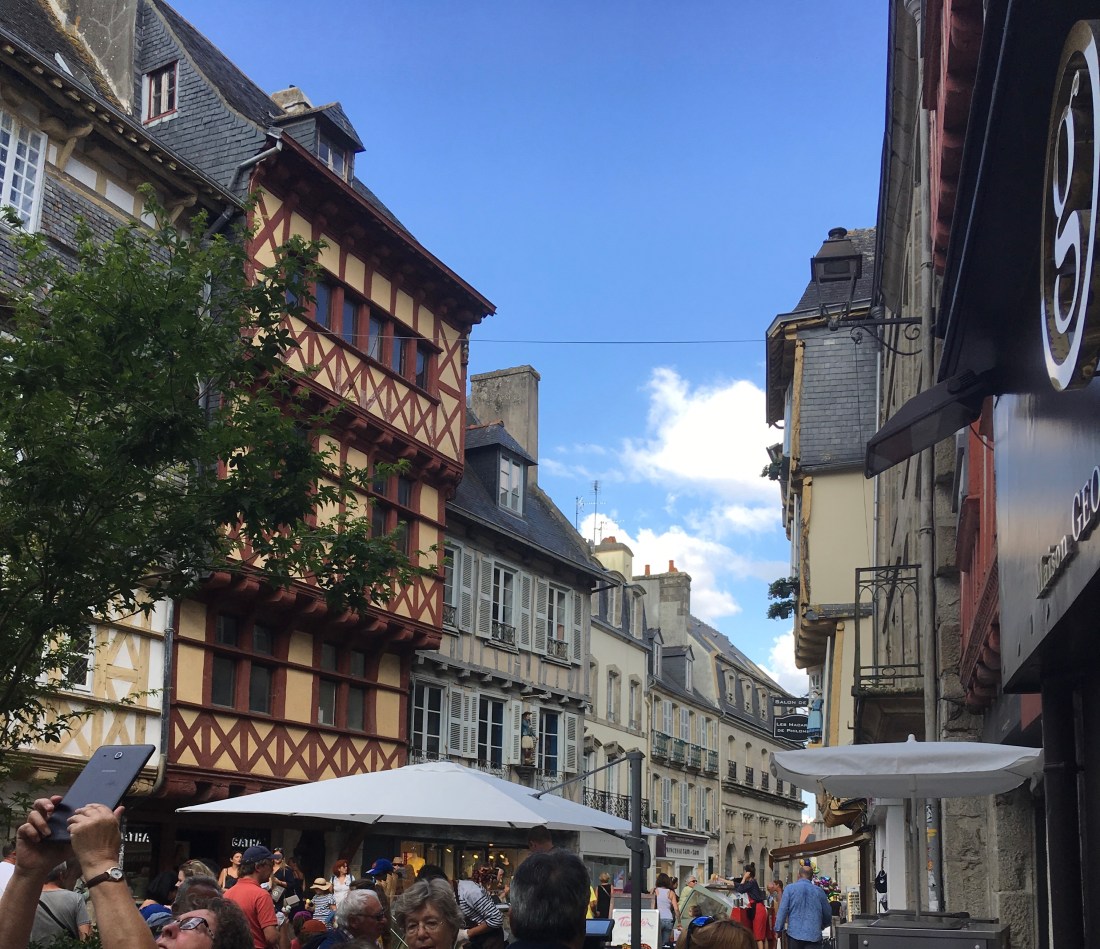
This is the street where our apartment-to-be is located!Our apartment is two buildings to the right of the yellow one with red half-timbering
The timing is amazing.The fact is that Kathleen wanted to book plane tickets for a week or so later than we did, to make sure that the sale of our home in Seattle had time to close.But John insisted on leaving no later than we did, and since he is usually so amenable and rarely makes demands, Kathleen conceded to his request.At some level did he know that there was a reason to arrive when we did?For if we had come the following week, Evelyne’s apartment would already be under contract, so desirable is the location and the home itself.In fact she gave us a few days to think about it and held it in priority for us, while still showing it to other buyers—2 of whom continue to phone her to see if it is back on the market!
We will share more about the apartment and the lovely Evelyne in another post, as this is already too long (we hope future posts will be shorter and more frequent!).Mainly we want to share now how magical it all feels, how this opportunity as well as all of the time since we arrived seems to confirm our decision to take on this new Adventure.We feel blessed on this path, and held and carried with great beneficence.
Watch this video for a sight-and-sound experience of how we are feeling welcomed in Bretagne!








 One Wild and Precious Life